Summer Heat Garage Door Problems in Florida
Garage doors fail more in a Florida summer because the garage sits over 100°F and cooks opener logic boards and old plastic gears, humidity rusts springs and cables, afternoon storms put water at the seal and spider webs across the photo eyes, lightning surges kill receivers, and power outages leave people stuck without a working manual release. Opener repair is $95 to $300 and most of the rest is preventable with a tune-up at $85 to $160 in April or May.
July and August are our busiest months, and not for the reason people expect. Springs fail on cycles, not temperature. What the Florida summer does is cook the opener, rust everything that is not sealed, throw water and spiders at the safety system every afternoon, and then cut the power. This is what fails, why, and what to do about it before June.
What fails in July and August
| Fault | Cause | What it costs |
|---|---|---|
| Opener dead or intermittent | Logic board or capacitor cooked by a 100°F garage, or a lightning surge | Opener repair $95 to $300 |
| Opener runs, door does not move | Stripped plastic drive gear in an older chain drive unit | Opener repair $95 to $300 |
| Door will not close, light flashes | Photo eyes blocked by webs, mud daubers, rain or low sun | Usually free to fix yourself |
| Door reverses on the way down | Friction up from rust or dry hinges, force limit marginal | Tune-up $85 to $160 |
| Loud bang, door will not open | Spring at the end of its cycle count | Spring replacement $150 to $350 per spring |
| Door heavy after a storm | Water in a wood door, or a cable that has rusted through | Cable repair $95 to $300 |
| Stuck inside during an outage | No battery backup, manual release never tested | Battery backup adds $60 to $150 |
Heat: the opener is the victim
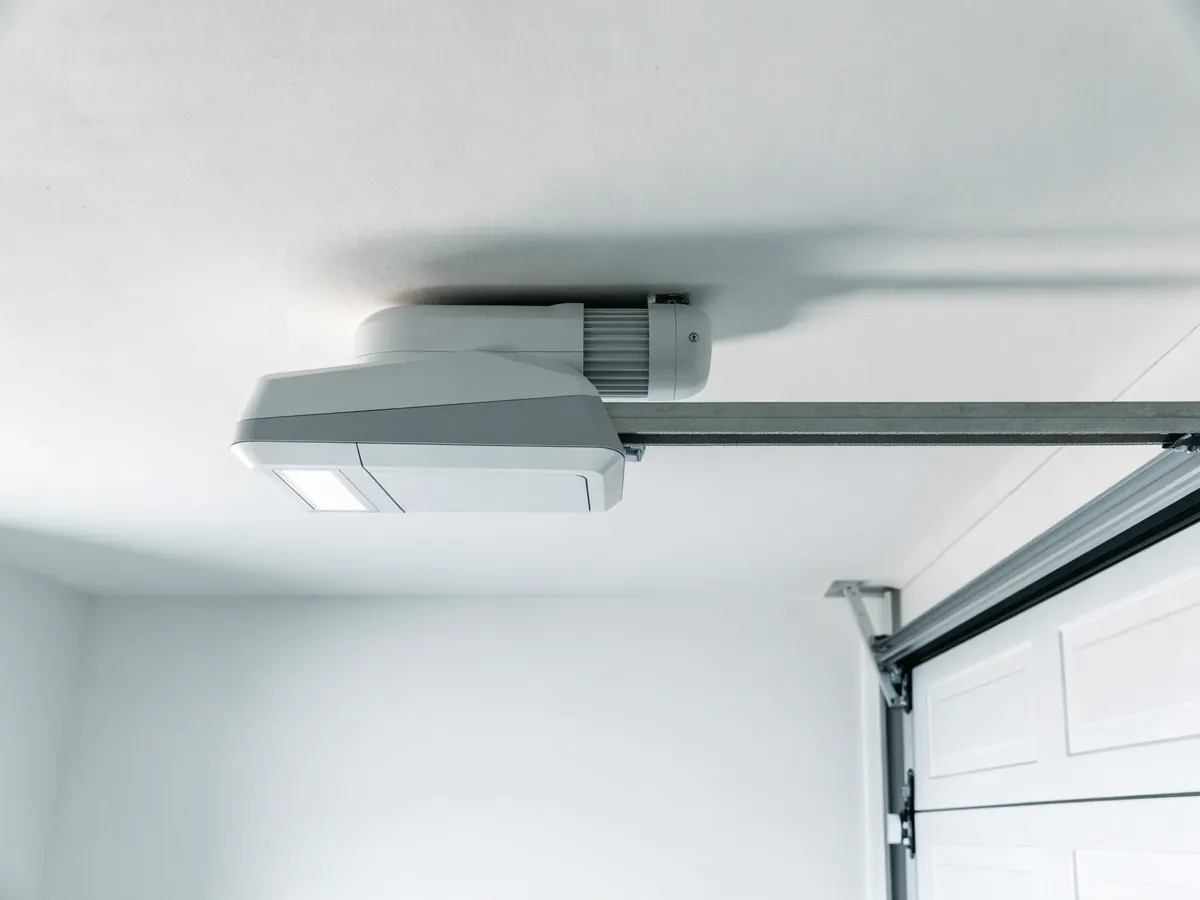
The door itself does not mind heat. The opener does. A closed Florida garage runs 100°F to 110°F on a summer afternoon, and the motor unit hangs at ceiling height where it is hottest.
Logic boards and capacitors. Electronics age faster hot. A board that was fine in March starts dropping out at three in the afternoon in July, then works again at nine at night when the garage cools. That pattern, working in the evening and failing in the heat of the day, is the board or the start capacitor. Our guide on what to do when a garage door opener quits working walks through the diagnosis. Opener repair is $95 to $300.
Plastic drive gears. Older chain drive openers, the kind still hanging in 1990s garages across Coral Springs, Pembroke Pines, Brandon and Oviedo, drive the chain through a nylon gear. Heat softens it, grease runs out of it, and one day the motor hums but the door does not move, with a small pile of white shavings on top of the unit. Our guide on an opener that runs while the door does not move covers it. On a unit over fifteen years old, a gear kit at $95 to $300 is worth weighing against a new opener installation at $275 to $600.
Lubricant. Heat thins it and runs it off the spring, the hinges and the rollers, which is why we say three rounds a year here rather than two. Our guide on how to lubricate a garage door in Florida humidity covers what survives.
Humidity: everything that is not sealed rusts
A summer garage sits at 80 to 90 percent humidity, and nothing dries out until November.
Springs pick up rust between the coils, which adds friction and starts the pitting that becomes a crack. Cables rust where they anchor at the bottom bracket, which sits in water after every storm. Hinges bind at the pivot. Open bearing steel rollers seize from the inside.
The result on the driveway is a door that has gradually got heavier and slower, until the opener’s force limit reads the extra friction as an obstruction and reverses. Our guide on why a garage door opens slowly covers that chain. Near either coast, salt air speeds all of it up, and our guide on salt air corrosion explains which parts go first.
Afternoon storms: water and spiders
From June to October, most of the state gets a storm most afternoons, and two things follow.
Water at the seal. Runoff pools at the bottom of the door every day. A flattened or torn bottom seal lets it inside, where it sits against the bottom brackets and the jamb. A wood door swells and gets heavier. A wood jamb rots and the track brackets loosen. Check the seal monthly through the wet season, and if water is coming in every afternoon, our guide on garage door jamb replacement in Florida explains what it leads to.
Photo eyes. The sensors at the bottom of the track are the most common summer call we get, and most of them cost nothing to fix. Spiders and mud daubers build on the lenses through the summer, wind-driven rain gets across the beam, and on a west facing garage the low afternoon sun can blind the receiving eye directly. The door will not close, the opener light flashes, and the fix is wiping both lenses, checking the brackets have not been knocked, and shading the sensor from the sun. Our guides on why a garage door will not close and what the flashing opener light means go through it.
Lightning: the surge that kills the receiver
Florida has more lightning strikes than any other state, and summer is when they happen. A surge through the power line, or through the low voltage wiring to the wall control or the sensors, takes out the opener’s logic board. The pattern is simple: the door worked before the storm, and afterward the remotes do nothing, or nothing does anything at all.
A surge protector on the opener outlet is cheap and worth fitting in May. If the board is already gone, opener repair is $95 to $300, and on an old unit a new opener at $275 to $600 is the better spend.
Power outages: the manual release and the battery
After a storm, the power goes out, and a garage door with no battery backup is a wall. This is where Florida differs from everywhere else: the outage is not a rare event, it is a season.
Test the manual release in May, not during the outage. With the door closed, pull the red cord and lift the door by hand. If it lifts easily and stays where you put it, the springs are balanced and you can get out. If it is heavy or drops, the springs are weak, and you need to know that now rather than with a hurricane coming. Our guide on how to use the manual release covers reconnecting afterward.
Battery backup adds $60 to $150 to any new opener and runs the door for a couple of days of normal use with the power out. On a smart opener at $350 to $750 it is usually built in, along with a phone app that tells you whether the door is closed when you are evacuated three counties away. Our guide on garage door battery backup for power outages covers what to look for.
Springs: more cycles, not more heat
Springs fail on count. Summer in Florida means school is out, the family is home, and the garage door runs ten or twelve times a day instead of six. A spring that had a few hundred cycles left in June is gone by August. Spring replacement is $150 to $350 per spring, both together adds $120 to $250, and a same-day call-out with the car inside adds an emergency premium of $150 to $300. Our guide on how long garage door springs last in Florida explains how to estimate your own count.
The May checklist
Everything below takes half an hour and prevents most of the above, and it doubles as the pre-hurricane check.
- Balance test. Release the opener, lift the door halfway, let go. If it does not hold, the springs are already tired.
- Lubricate properly. Garage door silicone or lithium spray on hinges, roller bearings, spring and end bearings. Not the track.
- Clean the photo eyes and check they point at each other.
- Check the bottom seal. Replace it if it is cracked, flattened or torn.
- Tighten the hardware. Hinges, track brackets, opener mount.
- Test the manual release.
- Surge protector on the opener outlet.
- Confirm the door is rated. If it is not, our guide on preparing a garage door for a hurricane is the next thing to read.
Or book a tune-up at $85 to $160 and we do all of it, plus the force and travel settings on the opener. We cover the state, from Palm Beach and the Treasure Coast to Tampa Bay, and May fills up.
Every price on this site is a starting price for a standard single door, and you get a written estimate before any work begins. The full list is on our prices page.
Related questions
Why does my garage door opener only act up in the afternoon?
Two common reasons. Low afternoon sun hitting a west facing photo eye can blind it, and the door refuses to close until the sun moves. And a logic board or capacitor that is marginal will fail at the hottest point of the day and work again in the evening. Shade the sensor for the first one. The second one is a repair at $95 to $300.
The power is out and my door will not open. What do I do?
Pull the red manual release cord with the door closed, then lift the door by hand. If it is too heavy to lift, the springs are weak or broken and you should not force it. When the power is back, reconnect by pulling the cord toward the motor and running the opener. A battery backup, $60 to $150 on any new opener, avoids the whole exercise.
My door will not close during a thunderstorm. Why?
Usually the photo eyes. Wind-driven rain, a spider web, or a mud dauber nest on a lens breaks the beam and the opener treats it as an obstruction. Wipe both lenses and check the brackets. If the opener light flashes ten times, that is the sensor code.
Do springs break more in summer in Florida?
Slightly, and not from the heat. School is out, the family is in and out all day, and the door cycles more. A spring near the end of its count gets there faster. Spring replacement is $150 to $350 per spring.
What should I do in May to avoid all this?
A tune-up at $85 to $160, or the checklist yourself: balance test, lubrication, tighten the hardware, clean the photo eyes, test the manual release, and put a surge protector on the opener outlet. Then check the seal and the sensors monthly through the wet season.