
How Long Do Garage Door Springs Last in Florida?
A standard garage door torsion spring is rated for about 10,000 open and close cycles, which is seven to ten years for a household that runs the door three or four times a day and closer to three or four years for a Florida family that uses the garage as the front door. Humidity and salt air corrode the coils and shorten that further near the coast. Spring replacement costs $150 to $350 per spring installed, and replacing both together adds $120 to $250 for the second.
In Florida, springs fail from cycle count and nothing else, and Florida doors cycle hard. The garage is the storage room, the workshop and the second front door, and a spring that would last a decade somewhere else can be finished in four years here. Add humidity and salt air eating the coils, and the honest answer to “how long” depends more on your driveway than on the spring.
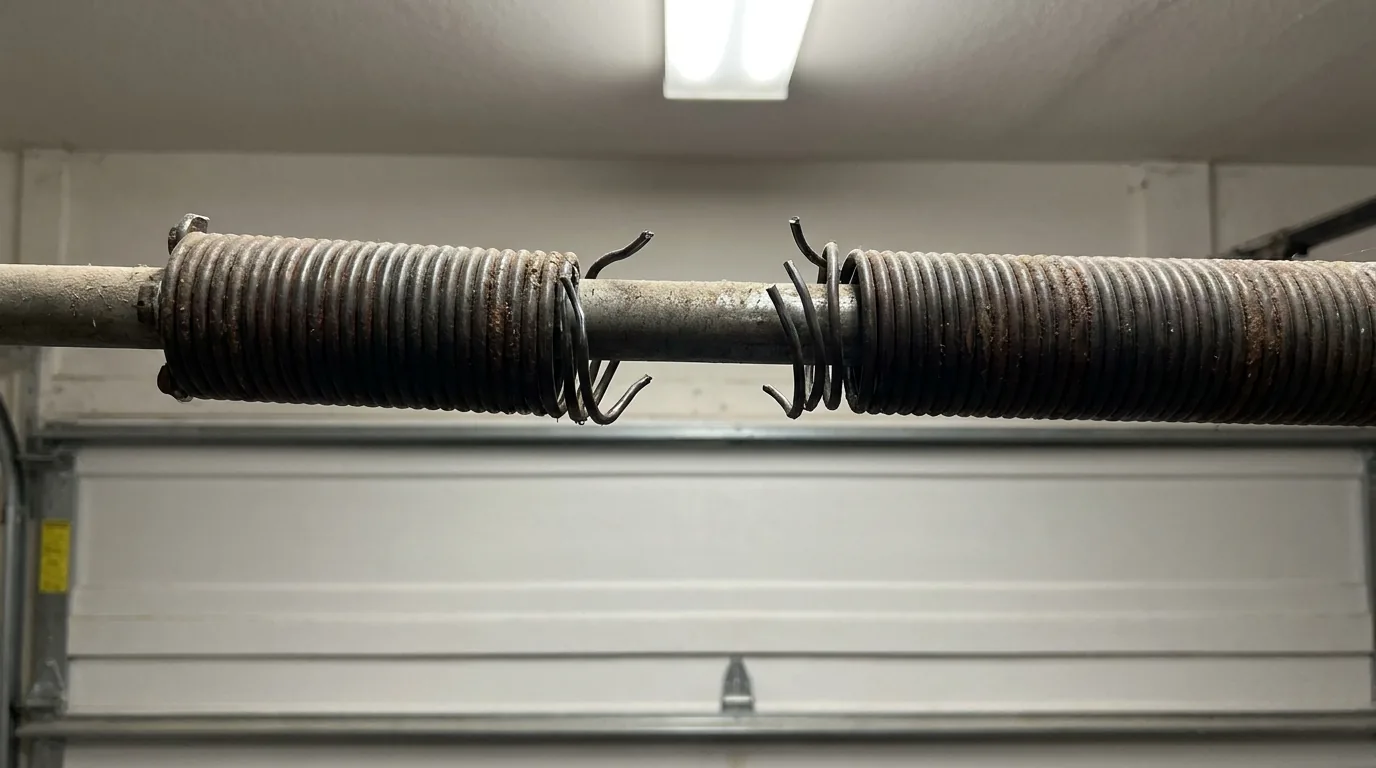
Cycles, not years
This is the thing most people get wrong. A spring does not fail because it is old. It fails because it has been wound and unwound a certain number of times and the steel has fatigued.
One cycle is one full opening plus one full closing. A standard residential torsion spring is rated for about 10,000 of them. High-cycle springs are rated for 25,000 or more.
Work out your own number
| Cycles per day | Cycles per year | Expected life, 10,000 cycle spring |
|---|---|---|
| 2 | 730 | About 13.7 years |
| 4 | 1,460 | About 6.8 years |
| 6 | 2,190 | About 4.6 years |
| 8 | 2,920 | About 3.4 years |
| 10 | 3,650 | About 2.7 years |
A household with two drivers who each leave and return once a day is running four cycles. Add the school run, the trash, the dog, a delivery, and kids going in and out of the garage for bikes and the second fridge, and you are at eight without noticing.
This is why springs in the newer subdivisions across Wesley Chapel, Riverview, Clermont and Port St. Lucie, where the builder fitted a standard pair in the mid 2010s and the family has used the garage as the front door ever since, are failing now, in a wave. And why a spring in a golf cart community, with the cart going out twice a day on top of the car, fails sooner still.
What shortens the count
Humidity. Steel that never dries rusts. A Florida garage sits at 70 to 90 percent humidity for most of the year, and an unlubricated spring picks up surface rust between the coils. Rust between coils adds friction on every cycle and starts the pitting that becomes a crack.
Salt air. Corrosion at the coils creates stress concentrations. Within a few miles of either coast, from Jupiter and Delray Beach to Cape Coral, Venice and Clearwater, springs fail earlier than the cycle count alone would predict. Our guide on salt air and garage door corrosion covers what else goes first.
An unbalanced door. If the spring is undersized for the door, it works outside its design range on every single cycle. Builder grade springs on a door that later had windows, insulation or a hurricane bracing kit added are a common version of this.
Poor lubrication. A dry spring has more friction between coils and heats slightly under load. In Florida, three spray applications a year rather than two, because humidity strips it faster. Our guide on how to lubricate a garage door here covers what to use.
Heat, indirectly. A garage at 100°F does not weaken spring steel. It does thin lubricant and run it off the coils, which brings you back to the point above.
Storm pressure. A door that has been bowed by wind, even without visible damage, can have shifted the drums and cables and left the springs loaded unevenly. After any named storm, a balance test is worth ten seconds.
Signs a spring is near the end
- The door feels heavy or sinks when you lift it by hand with the opener released
- The opener strains, stops partway, or reverses on the way up
- A gap has opened in the coil, or the coils are separating unevenly
- Rust bloom across the spring, or flakes on the floor beneath it
- The door opens crooked, because one spring of a pair has weakened more than the other
- A loud bang from the garage. That is the sound of a spring letting go, and our guide on what to do about a broken spring starts there
The test that tells you where you are
With the door closed, pull the red manual release. Lift the door to waist height by hand and let go.
A healthy door stays there. A door that sinks slowly has springs losing tension. A door that drops has springs that are effectively finished.
Do this every April, before hurricane season, and once more in November. It takes ten seconds and it is the single most useful thing you can check on a garage door.
High-cycle springs
A high-cycle spring is physically larger: thicker wire, more coils, longer. It stores the same energy across more material, so each coil works less hard.
| Rating | Life at 4 cycles a day | Life at 8 cycles a day | Price |
|---|---|---|---|
| 10,000 standard | About 6.8 years | About 3.4 years | Toward the bottom of $150 to $350 per spring |
| 25,000 high-cycle | About 17 years | About 8.6 years | Toward the top of $150 to $350 per spring |
They need room on the torsion tube, so they do not fit every low headroom garage from the 1950s to 1970s. On a busy door they are usually the cheaper option over ten years, because the visits cost more than the springs. Our guide on whether high-cycle springs are worth it in Florida does the full arithmetic.
Replacing before it breaks
Springs give very little warning, which is the argument for replacing on schedule rather than on failure.
The economics are simple. Spring replacement costs the same whether you plan it or not, $150 to $350 per spring, with both springs together adding $120 to $250 for the second. Except that when you plan it, you pick the day, you are not paying an emergency premium of $150 to $300 for same-day dispatch, and your car is not trapped in the garage at seven in the morning. We replace both springs on a two spring door, because the second one has the same count on it as the one that broke.
If the balance test says the springs are going and hurricane season is close, book it in April or May with a tune-up at $85 to $160. We cover the whole state, from Central Florida to Southwest Florida and North Florida.
Every price on this site is a starting price for a standard single door, and you get a written estimate before any work begins. The full list is on our prices page.
Related questions
How do I know how many cycles my spring has left?
You cannot measure it directly. Estimate it: count how many times a day the door runs, multiply by 365, and divide 10,000 by that. Four times a day gives about seven years. Eight gives about three and a half. It is an estimate, not a countdown, but it is close enough to plan around.
Do garage door springs fail more in summer?
In Florida, slightly, and not because of the heat itself. Summer is when the door cycles most, with school out and the family in and out all day, and a spring near the end of its count gets there faster. The failure is still about cycles, not temperature.
Does salt air really shorten spring life?
Yes. Corrosion at the coils creates stress points where the steel cracks before it would have from fatigue alone. Within a few miles of either coast, we replace springs that should have had years of cycles left. A galvanized or coated spring and regular lubrication slow it down.
Should I replace a spring before it breaks?
If the balance test shows the door sinking, or the springs are past their estimated count, yes. It costs the same, $150 to $350 per spring, except you choose the day, you avoid the $150 to $300 emergency premium, and your car is not stuck inside.
Are high-cycle springs worth it here?
On a door used six or more times a day, usually yes. A 25,000 cycle spring lasts about two and a half times as long, sits toward the top of the same $150 to $350 range, and saves whole service visits over ten years.