How to Prepare Your Garage Door for a Hurricane
Before a hurricane, close the garage door, pull the manual release so the opener cannot lift it, and engage the slide lock or clamp the track so wind pressure cannot move it. Know whether the door is rated for your site, because bracing kits are only an option where they carry a Florida Product Approval and are not the accepted route in Miami-Dade or Broward. A pre-season tune-up is $85 to $160, and if you need the door assessed and secured after the storm passes, storm damage repair starts at $150.
Why the garage door is the first thing to check
The garage door is the largest opening in the house. If it fails in a storm, wind enters, the house pressurizes, and the roof is at risk. That is why the Florida Building Code treats it as structural, and why the garage door is on every serious hurricane checklist ahead of the patio furniture.
Preparing it takes an afternoon, most of it before the season starts. Here is what we do on our own doors and what we tell every customer who calls in May.
Step 1: know your rating
Every rated door carries a factory label, usually on the inside of an end stile or the top section. It names the manufacturer, the model, and either a Florida Product Approval number (an FL number) or a Miami-Dade NOA number. Photograph it now while you can read it.
If there is no label, check whether the county has a permit on file for the door. A permitted door has its rating recorded on the permit. No label and no permit almost always means an unrated door, which is common on houses built before the modern code and on doors replaced without a permit since.
An unrated door is the single biggest weak point on a Florida house, and it is worth knowing that in March rather than discovering it in September. Hurricane-rated door installation runs $1,800 to $6,500 installed with the permit included, and the best time to do it is March to May, when lead times are shortest.
Step 2: bracing, only where approved for your zone
Retrofit bracing kits are vertical posts that anchor to the floor and the header and stiffen the door against pressure. They exist, they have Florida Product Approval in most of the state, and they are cheaper than a new door.
Two limits, and they matter:
- The kit has to be approved for your door and your wind zone. An approval is specific to door sizes and pressures. A kit that is approved for a 16 foot door in an inland zone is not automatically approved for the same door near the coast.
- In the HVHZ, the accepted route is a rated door. Miami-Dade and Broward do not use bracing kits as the path to compliance. If you are in Miami-Dade County or Broward County, read HVHZ garage doors explained before spending anything on a kit.
Kits also need to be installed the way the approval describes, with the right anchors in the slab and the header, and it takes time. Fitting one the evening before landfall with whatever screws are in the drawer is not protection. No kit makes a door immune to a storm, and a kit that is not approved for your door does not make it stronger in any way an inspector or an insurer will recognize. We cover the options in garage door hurricane bracing kits.
Step 3: the pre-season tune-up
A door that is loose, worn, or out of balance takes storm loads badly. Rollers that wobble in the track, hinges with play, and a bottom bracket with rust through it are the parts that give first. A tune-up at $85 to $160 tightens hardware, checks balance, replaces a worn roller or two, and tells you what is at end of life. April and May are the right months, before the June 1 rush.
Check the weatherstripping at the bottom and the sides while you are at it. Afternoon storms put water at the bottom seal daily for half the year, and a seal that is cracked or flattened lets water in during the storm and every day after.
Step 4: the day before, in this order
| Task | How |
|---|---|
| Close the door fully | Use the opener, then check the bottom seal is flat on the slab |
| Disconnect the opener | Pull the red manual release cord so the motor cannot lift the door |
| Lock the door | Engage the slide lock if the door has one, or clamp the track just above a roller on each side with locking pliers |
| Clear the garage | Anything against the door or the tracks becomes a projectile inside if the door moves |
| Move the car back | Park inside, well back from the door, or elsewhere |
| Charge the battery backup | If the opener has one, confirm the light shows charged |
| Photograph the door | Inside and out, for the record if you need a claim later |
Disconnecting the opener matters because a storm can trip the opener, and because an opener trying to lift a locked door will strip its gear. Locking matters because pressure on the door tries to lift it out of the track, and a door held only by the opener’s trolley is not held.
Step 5: do not open it during the storm
Once the door is closed and locked, it stays that way until the storm has passed. Not to check on the car, not to look at the yard, not to let the neighbor in. The moment the door is open, the largest opening in the house is open.
If the power fails during the storm, the opener will not run. That is fine, because you are not opening the door anyway. This is where a battery backup earns its $60 to $150: not during the storm, but in the days after, when the power is still out and you need in and out several times a day.
Step 6: the manual release, after
When the storm has passed and the power is still out, the manual release is how you get the car out. With the door closed, pull the red cord, then lift the door by hand. A door with intact springs lifts with moderate effort and stays where you put it.
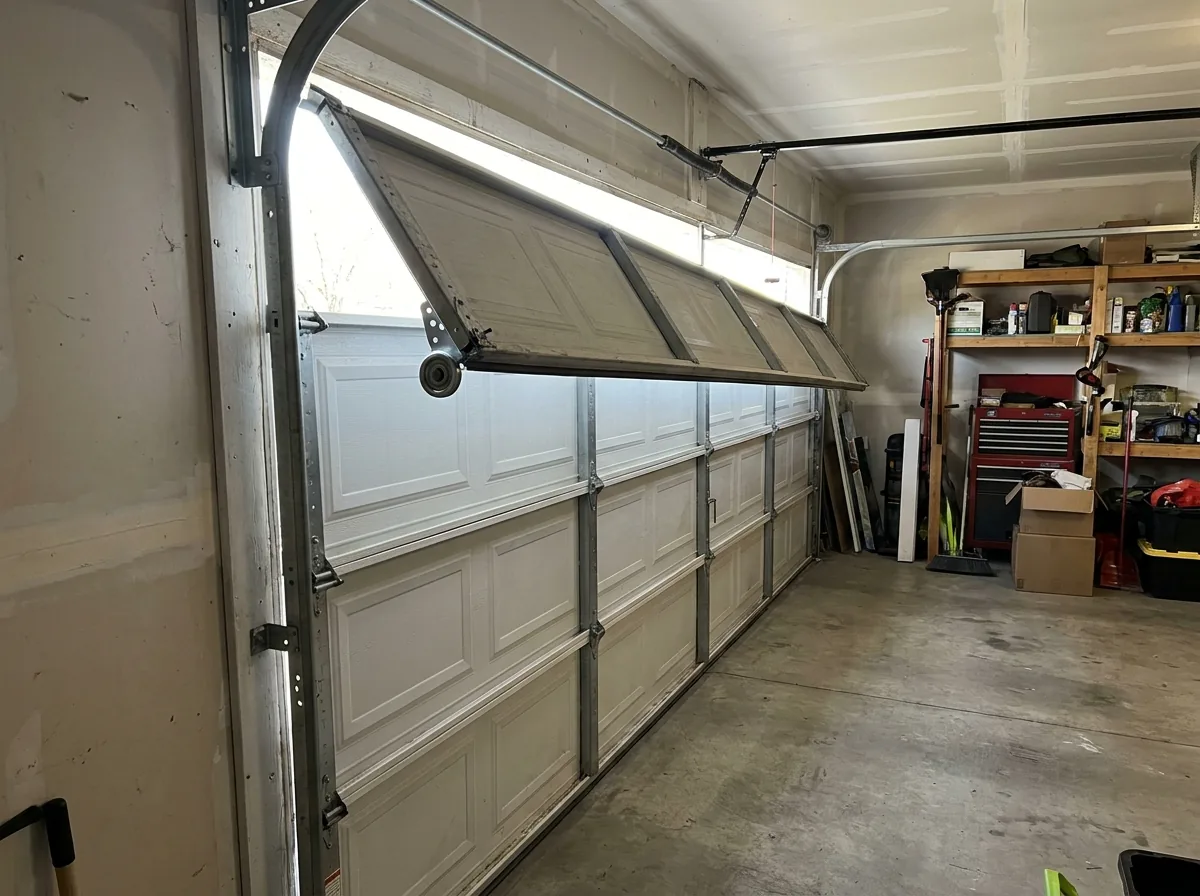
If it will not lift, or it drops when you let go, or it is much heavier than you remember, stop. A spring, a cable, or a bottom bracket has gone, and forcing the door will make it worse. Our manual release guide covers the details, including reconnecting once power returns.
Step 7: the after-storm inspection
Walk the door before you use it. Look for:
- Panels bowed inward or creased, even slightly
- Tracks pulled away from the jamb or bent
- Rollers out of the track on either side
- Cables slack, frayed, or off the drum
- The bottom bracket loose or bent
- Water or sand inside the tracks
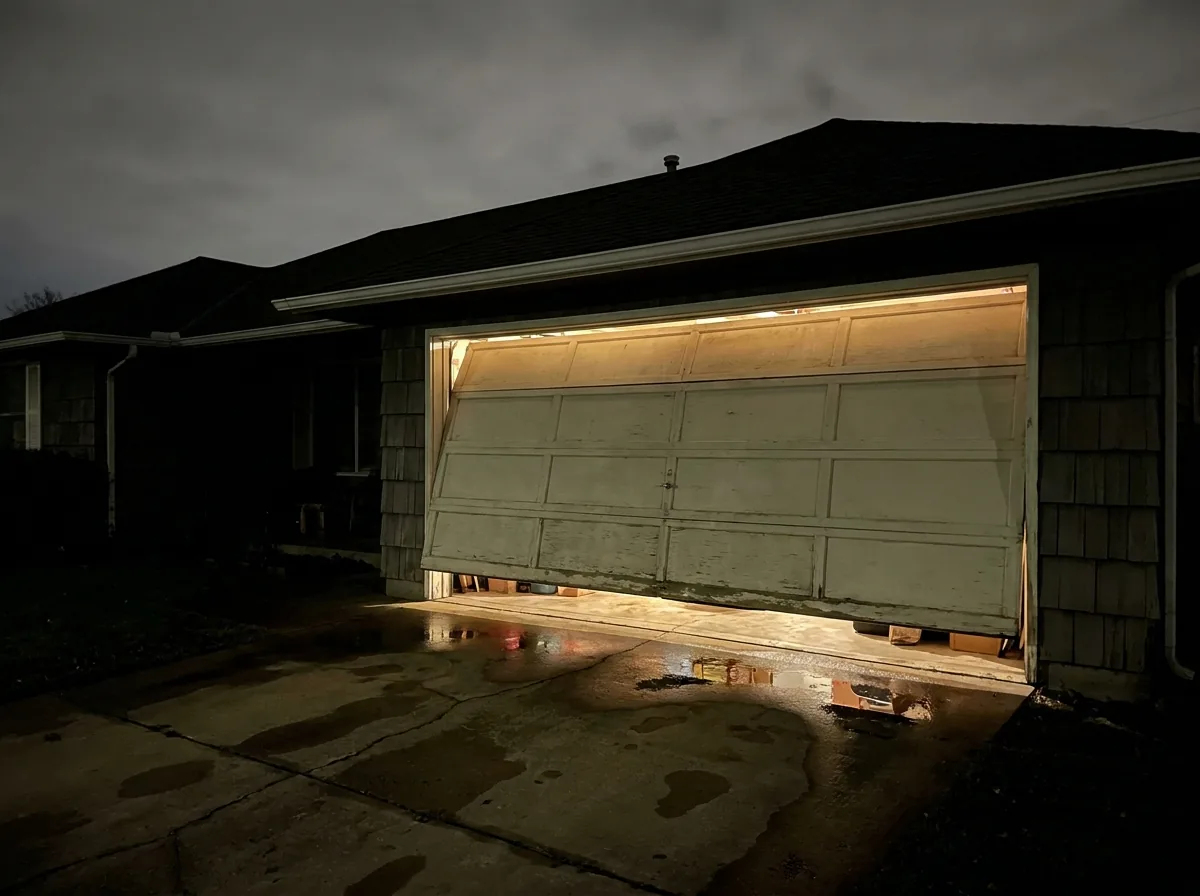
A door that looks fine but has a bent track or a creased top section will fail on the first cycle, sometimes at the bottom of the travel, sometimes half way up with the car underneath. If anything on that list is wrong, leave the door alone and call. Storm damage repair starts at $150 for assessment and securing the opening, and runs to $1,500 for bracing, panel or track work. Full replacement is quoted separately in writing. What to do when you find damage is in garage door storm damage: what to do.
The two things people get wrong
Leaving the door slightly open to “let the pressure out”. This is the most persistent bad advice in Florida and it is the opposite of what the code assumes. Close it.
Trusting a door because it has never failed. Many doors in Kendall, Homestead and Fort Myers were replaced after a storm and are now the age where springs, cables and brackets are at end of life. A door that stood through one hurricane with new hardware is not the same door with rusted hardware. Age and corrosion are covered in garage door rust in Florida humidity.
Related reading
- Wind-rated vs impact-rated garage doors
- Garage door wind mitigation insurance credit
- Garage door maintenance checklist
- Prices
Related questions
Should I leave the garage door open a little so pressure can equalize?
No. That is an old idea and it is wrong. An open door lets wind into the garage, the house pressurizes, and the roof takes the load. Close the door fully and lock it.
Can I park the car against the door to hold it?
No. A car does not brace a door, and a door that fails will push into the car and then into whatever is behind it. Park the car inside the garage, well back from the door, or somewhere else entirely.
How do I find out if my garage door is hurricane rated?
Look for the manufacturer's label on the inside of an end stile or the top section. It names the model and a Florida Product Approval number or a Miami-Dade NOA. No label, and no permit on file with the county, usually means an unrated door.
Is a bracing kit worth it before a storm?
Only if the kit has a Florida Product Approval for your door and your wind zone, and only outside the HVHZ. In Miami-Dade and Broward the accepted route is a rated door. A kit bought the day before landfall and fitted without the right anchors is not protection.
What if the power is out and I need to get out after the storm?
Pull the manual release cord with the door closed and lift the door by hand. It should lift with moderate effort if the springs are intact. If it will not lift, or it feels much heavier than usual, stop and call us, because a spring or cable has failed.