
Why You Should Never Replace a Torsion Spring Yourself
A wound garage door torsion spring stores enough energy to break bones, and it releases in a fraction of a second if it is not unwound under control with proper winding bars. It is the most common source of serious injury in residential garage door work, and it happens to capable people who underestimated the force. A replacement costs $150 to $350 per spring installed, which is the cheapest part of the whole equation.
What is stored in there
A residential garage door weighs 130 to 350 pounds. The springs hold all of it, which is why a balanced door feels like it weighs twenty pounds when you lift it by hand.
To do that, a torsion spring on a standard seven foot door is wound to somewhere between seven and nine and a half full turns. Every one of those turns is stored energy, and it stays stored for years, waiting.
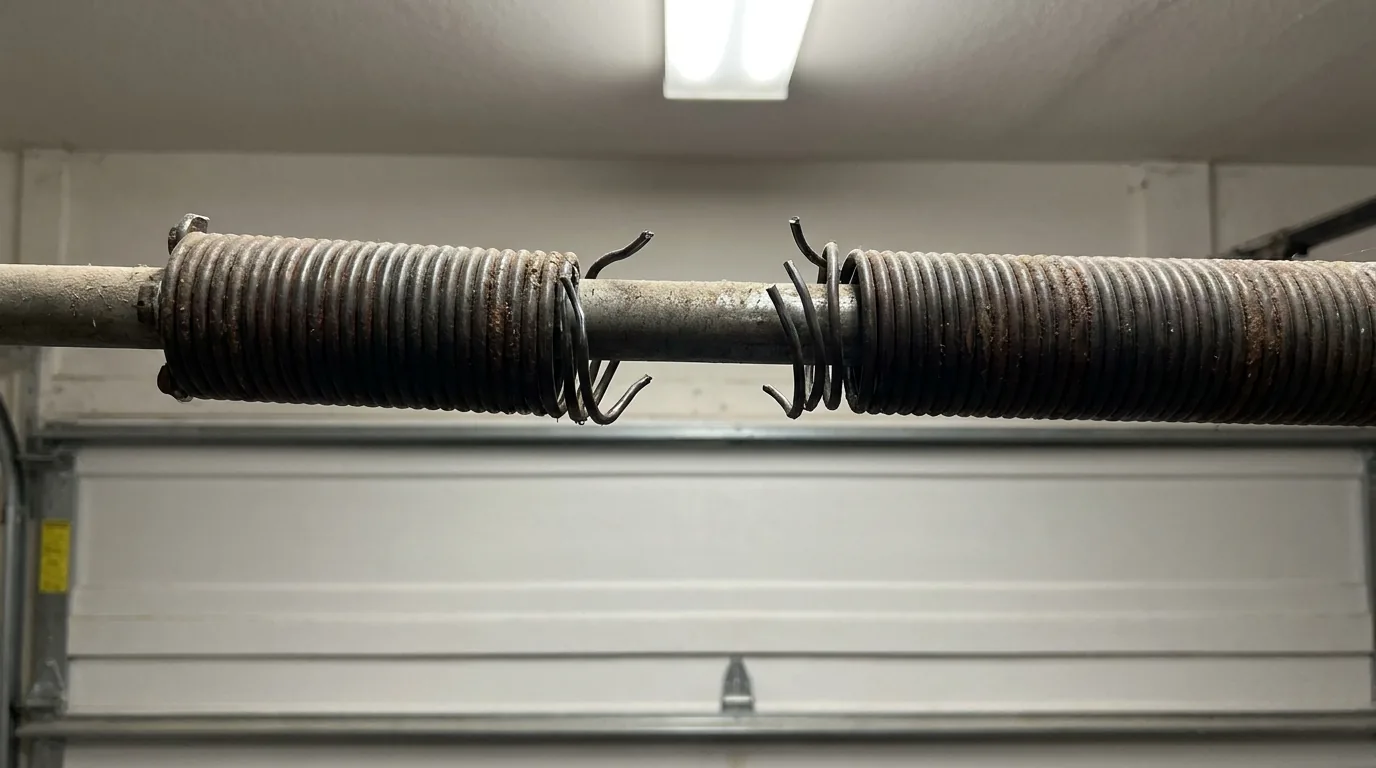
What goes wrong
The failures are not exotic. They are the same three every time.
Using the wrong tool. People use screwdrivers in the winding cone because they fit. They are not hardened, they are not the right length, and they slip. When a screwdriver comes out of a wound cone the spring unwinds instantly and the tool becomes a projectile at head height.
Losing grip. Winding bars are long for a reason: leverage. Nine turns of a heavy spring is more force than most people expect at the second or third turn, and a bar that slips out takes fingers with it.
Removing the wrong thing first. Undoing the bottom bracket, or the set screws on the winding cone, on a door that still has tension in it releases everything at once.
The injuries are broken fingers and hands, facial and skull injuries from bars and tools, and lacerations. Emergency departments see them every year.
Why a Florida spring is a worse bet
Springs here do not fail from cold. They fail from cycle count, and Florida doors cycle hard, six to ten times a day when the garage is the second front door. A 10,000 cycle spring lasts about seven to ten years in most of the country. In a busy Florida garage it can be closer to four or five.
Then there is rust. Humidity year round, and salt air within a few miles of either coast, pit the spring wire and corrode the winding cones, the set screws and the bottom brackets. That changes the job in three ways:
- A pitted spring can snap while it is being wound, with the bars in the cones and your hands on the bars.
- A rusted set screw strips or shears instead of releasing, and a cone that will not release cannot be unwound under control.
- A rusted bottom bracket bolt can shear when it is disturbed, and that bracket is holding cable tension.
Every one of those makes a job that is dangerous on a clean door more dangerous on a Florida door. Our guide on rust and Florida humidity covers what corrosion does to the rest of the hardware.
The part people underestimate
Even when a spring has snapped, the system is not safe.
The bottom brackets at the corners of the door anchor the lift cables, and those cables are still under load from the remaining spring, or from the weight of the door. Undoing a bottom bracket on a door that is not properly supported is how the most serious injuries in this trade happen.
There is a reason technicians treat bottom brackets with more care than anything else on the door.
Why the parts being cheap is a trap
A torsion spring costs $40 to $100 from a supplier, and that number is what draws people in. Against $150 to $350 installed it looks stark, until you understand what you are paying for.
You are paying for winding bars, for knowing the correct number of quarter turns for your specific door weight, for knowing which wire size, inside diameter and length your door needs, and for having done it enough times that the second turn is not a surprise.
Get the specification wrong and the door is permanently out of balance, which then destroys the opener. That is a common outcome of DIY spring work and it costs more than the spring did.
| Done properly | Price | DIY gone wrong | Price |
|---|---|---|---|
| One spring, installed and balanced | $150 to $350 | Wrong spring, door out of balance, opener stripped | $275 to $600 for a new opener |
| Both springs together | first spring plus $120 to $250 | Bottom bracket let go, panel bent | $250 to $800 per panel |
| Cable and drum with the spring | $225 to $400 | Cable off the drum, door off track | $140 to $600 |
| Balance test, reversal test, one year warranty | included | Emergency call at the weekend | $150 to $300 premium on top |
Our guide on spring replacement cost explains what moves the number, and torsion versus extension springs covers which type you have.
What you can do safely
Plenty, and it is worth doing:
- Lubricate hinges, rollers, springs and bearings twice a year. Our guide on how to lubricate a garage door has the steps.
- Rinse salt off the hardware with fresh water if you live near the coast, then dry and lubricate.
- Tighten hardware.
- Clean and align the photo eye sensors.
- Replace the bottom weather seal, which takes a beating from daily afternoon rain.
- Run the balance test and the reversal test.
- Keep the track clean and dry, never greased.
That list prevents most garage door failures. It just does not include the one part with a couple of hundred pounds of stored energy in it.
If a spring has already broken
Do not pull the manual release with the door up. Do not try to lift the door by hand. If the car is inside, our guide on a car trapped in the garage covers the safe options, and what to do with a broken spring covers the rest.
Spring replacement is $150 to $350 per spring, same day seven days a week. After hours or same-day dispatch through emergency repair carries a $150 to $300 premium, stated before we leave. Every price on this site is a starting price for a standard single door, listed on our price list. We cover the whole state, from Broward County to Tampa Bay.
Related questions
What about extension springs? Are they safer?
Not meaningfully. Extension springs stretch along the horizontal tracks and store the same kind of energy. They are the reason safety containment cables exist: without one, a failing extension spring becomes a projectile across the garage.
Can I replace the cables myself instead?
No. The cables are under full spring tension, and the bottom brackets they anchor to are under that tension even when a spring has broken. The bottom bracket is one of the most dangerous parts on a garage door, and in Florida it is often rusted to the point where the bolts shear.
Why is a rusty spring more dangerous to work on?
Rust pits the wire and creates weak points. A pitted spring can snap while it is being wound, with the bars still in the cones, and a rusted set screw or winding cone does not grip the shaft the way a clean one does. Humidity and salt air make this common within a few miles of either coast.
What can I safely do myself?
Lubrication, tightening hardware, cleaning and aligning photo eye sensors, replacing the bottom weather seal, rinsing salt off the hardware, and the balance and reversal tests. That is a genuinely useful list and none of it involves stored tension.
What does it cost to have it done properly?
$150 to $350 per spring installed, and both springs together adds $120 to $250 to the first. That includes the correct spring for your door weight, winding to the right number of turns, a balance test and a one year warranty on parts and labor.