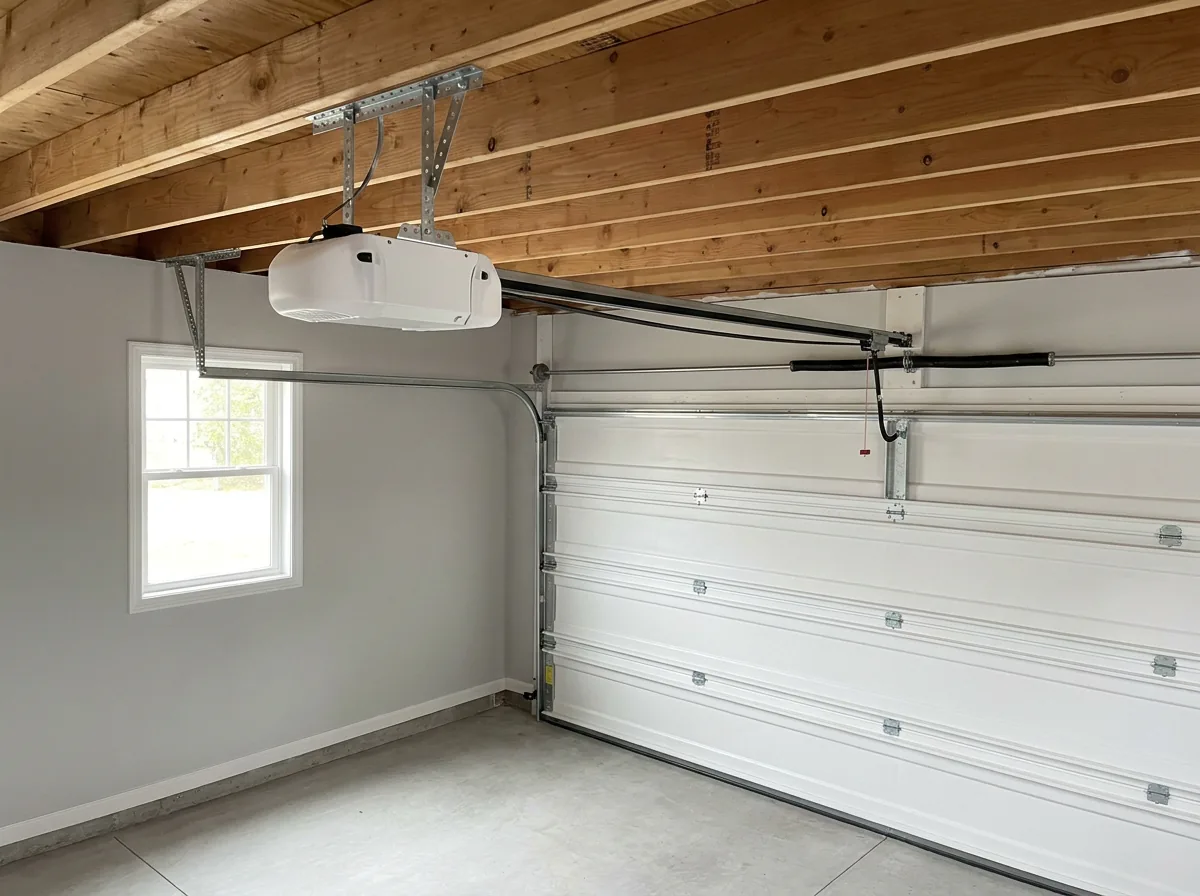
How Old Is Too Old for a Garage Door Opener in Florida?
A garage door opener made before January 1993 has no photo eye safety sensors and should be replaced whether or not it still runs. Past about fifteen years in a Florida garage, where summer temperatures pass 100°F and cook logic boards and plastic gears, parts availability decides the question. Any repair over half the price of a new unit, which is $275 to $600 installed, is not worth doing.
The 1993 line
Federal rules required an entrapment protection system on residential garage door openers manufactured from January 1993. Essentially every manufacturer met it with photo eye sensors: a beam across the opening near the floor that reverses the door when broken.
If your opener has no such sensors, it was made before that. It is over thirty years old and it has no automatic way to stop for a child, a pet, or anything else under a closing door.
That is not a maintenance issue. It is the whole argument for replacement on its own. Our guide to safety sensors explains what they do and how to test them.
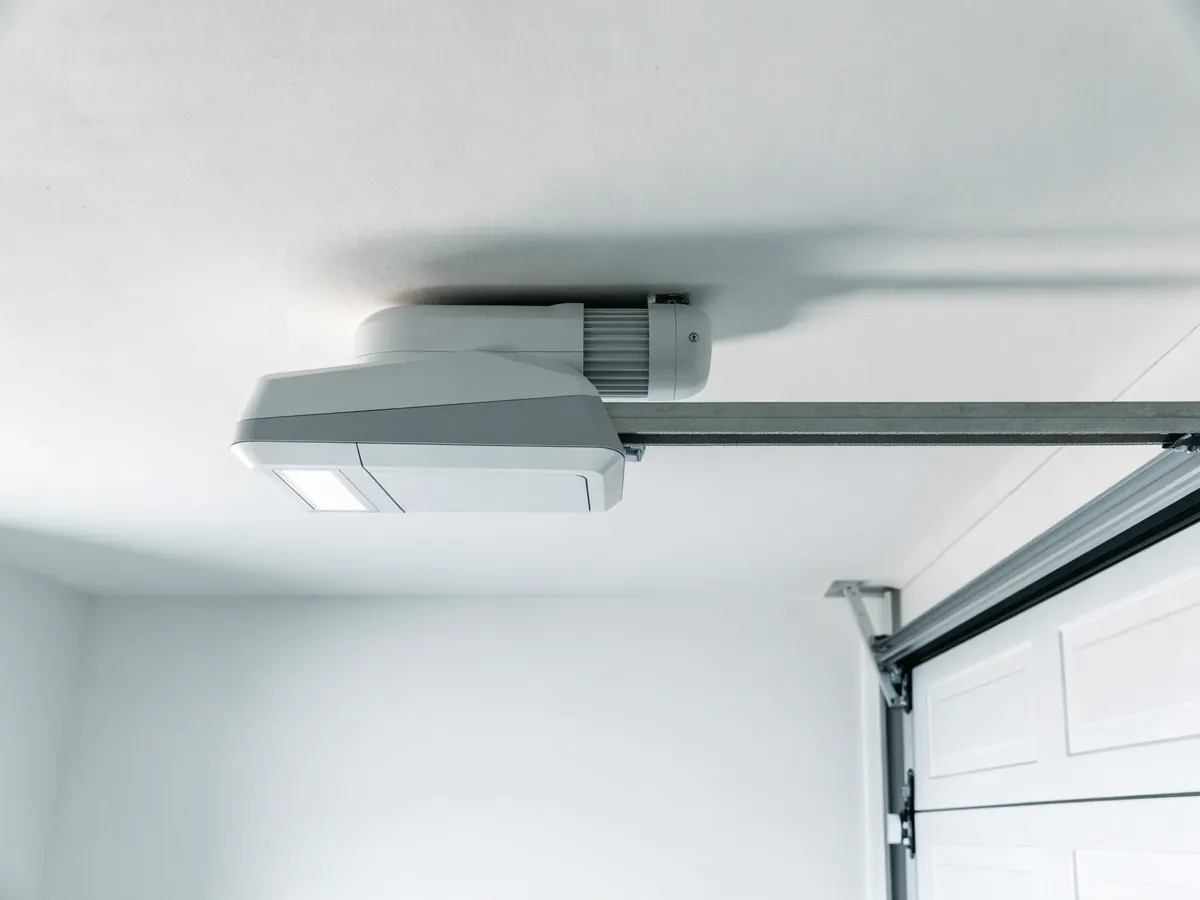
How to check
Look at the bottom of the track on each side of the opening, near the floor. Two small units facing each other, with wires running back along the wall, are photo eyes.
No sensors, no protection, and no adjustment that adds it.
Open a remote while you are at it. A row of tiny switches inside means a fixed code with a few hundred possible combinations, which a neighbor with the same brand can match by accident and a cheap scanner can copy on purpose. Our guide on a door that opens by itself covers why that matters.
What Florida heat does to an old opener
Springs do not fail from cold here. Openers fail from heat.
A closed garage in Kendall, Brandon or Cape Coral sits above 100°F most summer afternoons, and the motor unit is bolted to the ceiling where it is hotter still. Over fifteen or twenty summers that does specific things:
- Capacitors dry out. The start capacitor is the first thing to go. The motor hums and does not turn, or starts on the third press.
- Solder joints crack. The logic board expands and contracts every day for decades. Intermittent faults, remotes that work some days and not others, and lights that blink for no reason are the result.
- Plastic gears go brittle. Older chain and screw drive units use a nylon drive gear. Heat makes it brittle, and one day the motor runs and the door does not move. Our guide on an opener that runs but the door does not move covers that failure.
- Grease turns to varnish. Chain and screw drives run stiff, the motor works harder, and the board runs hotter.
None of this is fatal on a unit that is ten years old with parts on the shelf. On a unit from the 1990s it is a series of repairs with no end. Our guide on summer heat and garage door problems covers what else the heat attacks.
The parts availability line
Past about fifteen to twenty years, the question changes from safety to economics.
Manufacturers keep parts for a model for a number of years after production ends, then stop. Logic boards, travel modules and proprietary gear kits are the first to become unavailable.
Once parts are gone, a fault that would have been a $150 repair becomes a replacement, and you find that out at the worst possible time, which in Florida is a Sunday in August or the week after a storm.
The repair or replace arithmetic
| Situation | Answer |
|---|---|
| Under 15 years, common fault, parts available | Repair, $95 to $300 |
| Repair quote over half the price of a new unit | Replace |
| Parts no longer made | Replace |
| No photo eye sensors | Replace, regardless |
| Fixed code remotes with dip switches | Replace |
| Motor or gear already rebuilt once | Replace |
| Second board failure | Replace |
A new opener installed is $275 to $600 depending on drive type. Our guide on opener installation cost breaks down what moves the number.
What to get instead
Belt drive, $350 to $600, if there is living space above or beside the garage. Most Florida houses are single story with a bedroom sharing a wall with the garage, so this is the usual choice. Our guide on belt versus chain drive compares them.
Chain drive, $275 to $450, for a detached garage or a workshop where noise does not matter. Cheapest and durable.
Jackshaft wall mount, $450 to $800, if there is not enough headroom for a rail. Common in 1950s to 1970s single door garages in Hialeah, Hollywood east of I-95 and St. Petersburg. Our guide to low headroom openers covers the options.
Battery backup, $60 to $150 added to any of them. Power outages after storms are the Florida reason this exists, and our guide on battery backup and power outages explains how long one runs.
WiFi, if you are away from the house for part of the year. Seasonal residents in Naples or Sarasota who want to know the door is closed in July get more from a smart opener, $350 to $750, than from any other option on this list.
The thing to check before you spend
Pull the manual release and lift the door by hand. If it is heavy, or will not stay halfway, the springs are tired.
An opener guides a balanced door. It does not lift a heavy one. Fitting a new opener to a door with worn springs means buying the same opener again in a few years, and it is one of the most common ways people waste money on a garage. A spring replacement is $150 to $350 per spring, and doing it the same day as the opener saves a second visit.
What we charge
Opener repair starts at $95 and typically runs $95 to $300 for a board, gear kit, sensors or travel limits on a unit worth repairing. Opener installation is $275 to $600 with the unit included, and we take the old one away. One year on parts and one year on labor, written on the invoice.
Every price on this site is a starting price for a standard single door, listed on our price list, and you get a written estimate before any work begins. We cover the whole state, from Miami-Dade County to North Florida.
Related questions
How do I find out how old my opener is?
There is a label on the motor housing with the model number and usually a date code or serial number. If the unit has no photo eye sensors near the floor, it predates 1993 regardless of what the label says. A remote with a row of tiny switches inside is another sign of the same era.
It still works fine. Why replace it?
Because working and safe are different questions. An opener without photo eyes has no reliable way to detect a child or a pet under a closing door, and no adjustment adds that. It also almost certainly uses a fixed code that a neighbor's remote or a cheap scanner can copy.
Can I add sensors to an old opener?
Not reliably. The sensor system is built into the opener's logic board, and units that predate the requirement have no provision for it. Retrofit attempts do not produce a system you should trust a child's safety to.
Why do old openers fail in August?
Heat. A closed Florida garage passes 100°F most summer afternoons, and the motor housing near the ceiling is hotter still. Capacitors dry out, solder joints crack, plastic gears go brittle and strip, and the grease on a chain drive turns to varnish. A board that limped through spring often quits in the hottest month.
What does a new opener cost installed?
$275 to $600 for a standard unit, depending on drive type. Chain drive is $275 to $450, belt drive $350 to $600. Battery backup adds $60 to $150, and a WiFi smart opener with battery backup runs $350 to $750.