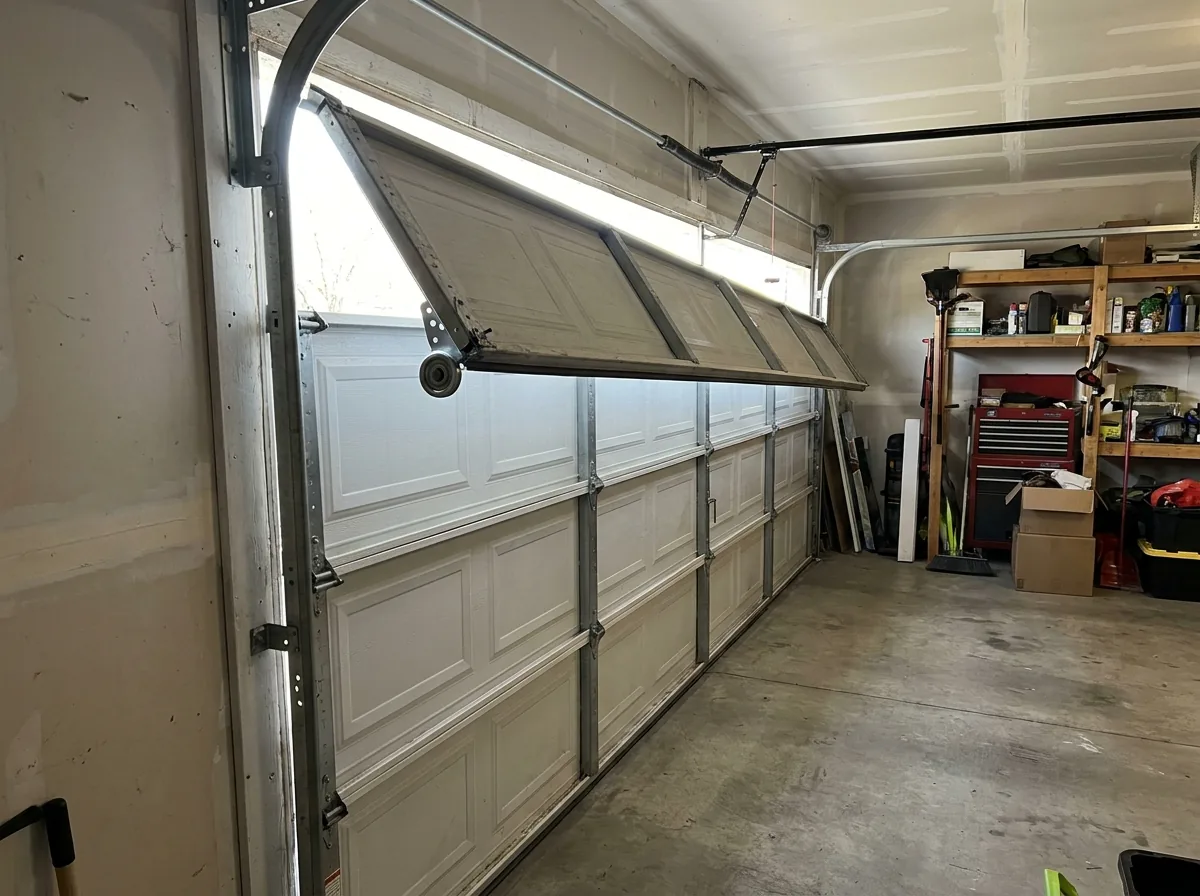
Garage Door Opens By Itself: Why It Happens and How to Stop It
A garage door that opens by itself is almost always one of five things: a stuck or water swollen button on a remote, keypad or wall control, an old opener from before rolling codes that a neighbor's remote can trigger, radio interference from an LED bulb, a wiring fault shorting the button circuit, or a logic board damaged by heat or a lightning surge. Openers made before roughly 1993 are the most common culprit. Opener repair runs $95 to $300, and a new rolling code opener installed runs $275 to $600.
Start by taking it seriously
An open garage door is an open door to your house. In Florida the garage is attached, the door into the kitchen or laundry is often unlocked, and the garage itself holds the tools, the bikes and often the golf cart.
So before you diagnose anything, secure it tonight. Unplug the opener at the ceiling outlet and pull the manual release, or use the lock button on the wall control if your unit has one. That mode disables every remote and keypad and takes one press. Our guide on garage door locks and security covers the manual slide lock for a door that has to stay shut.
Then work through the causes below, in order, because they are ordered by how often they turn out to be the answer.
One: a stuck or wet button
Unglamorous and extremely common, and in Florida the weather gets a vote.
The wall control, a remote in a car door bin, a remote clipped to the golf cart visor, a keypad outside with a swollen or jammed key. Any button held closed sends a continuous signal, and the opener does what it is told.
The outdoor keypad is the Florida suspect. It sits on the jamb taking direct sun all morning and a storm every afternoon for half the year. The rubber keys swell, the housing fills with moisture, and a key sticks down or the board inside shorts across two contacts. A keypad that is discolored, cracked or has water behind the cover is the first thing we look at.
How to test it. Take the batteries out of every remote in the house, the cars and the cart, and the battery out of the keypad. If the phantom opening stops, put them back one at a time over a few days until it returns. If it does not stop, you have ruled out remotes entirely and that is worth knowing.
Two: an old opener without rolling codes
This is the cause most people have never heard of and it explains a lot of the strangest cases.
Garage door openers made before roughly 1993 used a fixed code, set with a row of small dip switches inside the remote and a matching row inside the opener. There were only a few hundred or a few thousand possible combinations depending on the model.
That means a neighbor can be carrying a remote set to the same combination as yours. They press it for their door and yours opens too.
Florida makes this more likely than most places. Whole subdivisions in Coral Springs, Pembroke Pines, Brandon and Palm Harbor were built in a few years in the 1980s and early 1990s, with the same builder fitting the same brand of opener on every house. Where those openers are still running, they share a small pool of codes on a street of identical doors. Older single door houses in Hialeah, Hollywood and St. Petersburg have the same units for a different reason: the opener was never replaced.
How to tell which you have. Open the remote. A row of tiny switches inside means a fixed code opener. A circuit board and a battery means rolling codes.
The fix. If your opener is fixed code, no adjustment makes it secure. You either add a rolling code receiver to the existing motor, which is possible on some units, or you replace the opener. Given that a fixed code opener is at minimum thirty years old, has spent those years in a hot garage, and predates the safety sensor requirement, replacement is the honest recommendation rather than the upsell. Our guide on old opener safety covers the rest of what is missing.
Three: radio interference
Openers work on a narrow radio band, most commonly 315 MHz or 390 MHz in the United States. Several household things transmit noise in that region.
LED and CFL bulbs. The most common offender by a distance. Cheap LED bulbs in the opener itself, or in fittings near it, can produce enough radio noise to cause phantom operation and to shorten remote range. Bulbs sold as rated for garage door openers are shielded for exactly this reason.
Nearby transmitters. Florida has several military air bases, from MacDill in Tampa to Patrick on the Space Coast and Homestead in the south, and some of them use adjacent frequencies. If you live near one and the problem is intermittent and time patterned, this can be the cause, and the fix is an opener on a different frequency.
New electronics in the house. Baby monitors, wireless doorbells, cheap wireless cameras. If the problem started the week something new arrived, unplug that thing and watch.
Four: a wiring fault
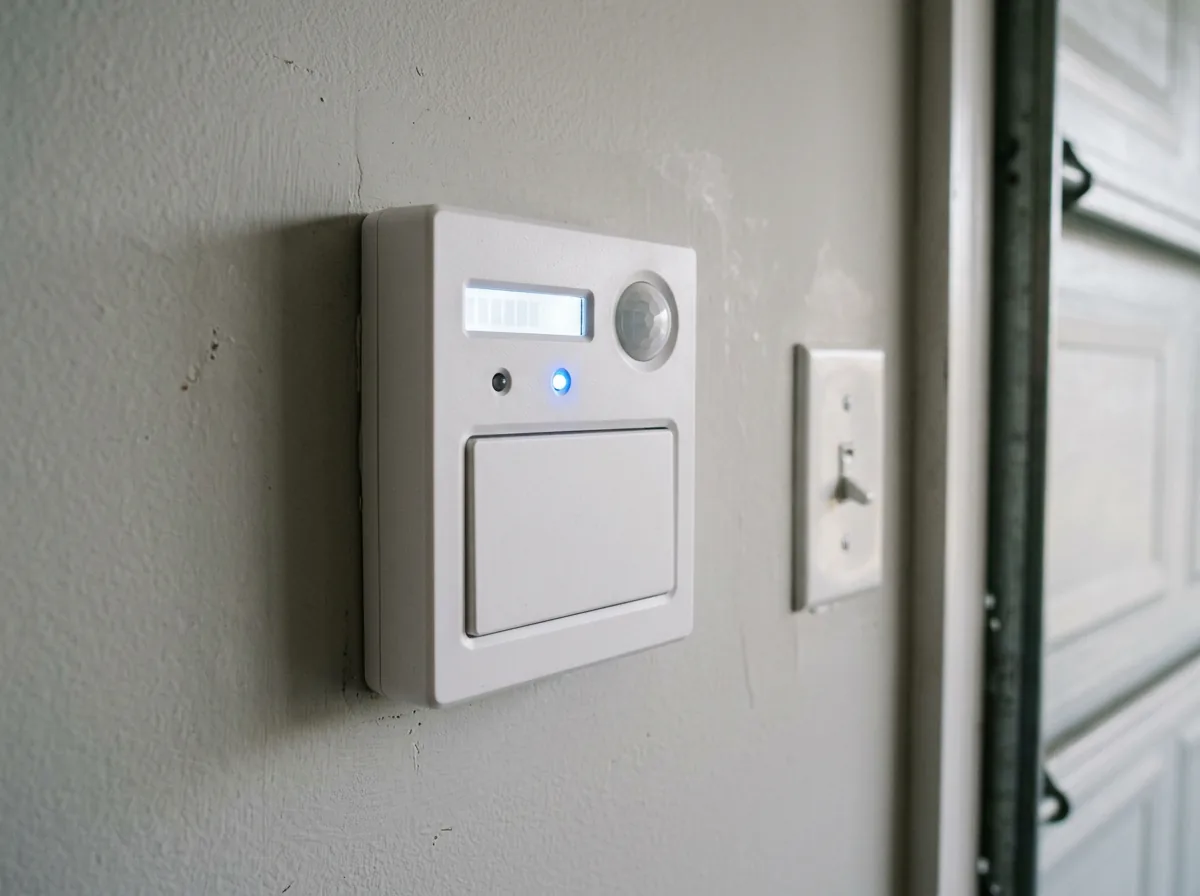
The wall control connects to the motor unit with two low voltage wires running along the wall and up. If those two wires touch anywhere along their run, the opener reads it as somebody pressing the button.
Staples driven through the insulation, a wire pinched behind a shelving unit, rodent damage, or corrosion where the wire runs along a damp block wall will all do it. Corrosion is the Florida one: the wire sits against block that wicks moisture up from the slab, and the insulation and the copper both give up over the years.
How to test. Disconnect the two wall control wires at the motor unit. If the phantom operation stops, the fault is in that circuit and not in the radio side. This is a five minute test and it splits the problem cleanly in half.
Five: a failing logic board
Last on the list because it is last in frequency, but Florida produces more of these than most places. A board with a failed relay, water in the housing, or damage from a lightning surge can trigger the motor with no input at all. Heat does its part too: a board that has spent ten summers above 100°F is not the board it was.
Symptoms that point this way: the door operates with every remote battery removed and the wall control disconnected, and the opener does other odd things such as lights turning on unprompted or the unit running for a moment when power comes back after an outage.
On an older unit, weigh the board price against a new opener before committing. Our guide on an opener that has quit covers that decision.
Causes, checks and costs
| Cause | What to check | What it costs |
|---|---|---|
| Stuck or swollen button | Pull every remote and keypad battery, inspect the keypad for water | New keypad or remote, an inexpensive part on an opener repair visit from $95 |
| Fixed code opener | Dip switches inside the remote | Rolling code receiver where possible, or a new opener at $275 to $600 |
| LED bulb interference | Swap the opener bulb for a rated one | The bulb |
| Wall control wiring shorted | Disconnect the wires at the motor and watch | Opener repair $95 to $300 |
| Logic board damaged by surge or heat | Runs with everything disconnected | Opener repair if the board exists; new opener if not |
| Want phone alerts, a camera and battery backup | Older opener, family in and out all day | Smart opener $350 to $750 |
Every price is a starting price for a standard single door. The full list is on our prices page.
The diagnostic order, condensed
- Secure the garage tonight. Unplug it or use lock mode.
- Remove every remote and keypad battery. Wait. Does it stop?
- Open a remote. Dip switches inside means a fixed code opener and that is very likely your answer.
- Change the opener bulb for one rated for the job.
- Disconnect the wall control wires at the motor unit. Does it stop?
- If it still happens with no remotes and no wall control, the board has failed.
Two things worth doing regardless
Lock the door between the garage and the house. Whatever the cause turns out to be, this is the difference between losing a bicycle and losing everything.
If your opener is fixed code, plan to replace it before the season. A modern opener with a rolling code, battery backup and a phone alert when the door opens costs less than most people expect, and the alert alone ends the mystery, because you will know the minute it happens. Our guide on whether a smart opener is worth it weighs the options. We serve the whole state, Miami, Fort Lauderdale, Tampa and beyond, same day, seven days a week.
Related questions
Can someone open my garage door with their own remote?
On an opener made before about 1993, yes, and not necessarily on purpose. Those units used a fixed code set by dip switches, with only a few hundred or a few thousand combinations. A neighbor with the same brand and the same switch positions can open your door from their driveway without knowing they are doing it. Every opener made since uses a rolling code that changes on each press, which closes that hole.
Is my garage door being hacked?
It is possible but it is not where you should start. Code grabbing attacks on fixed code openers are real and the equipment is cheap. Rolling code openers are a much harder target. In the great majority of the calls we take, the cause turns out to be a stuck button, a wet keypad or a neighbor's transmitter rather than anyone targeting the house.
Why did my door start opening on its own after I changed a light bulb?
Some LED and CFL bulbs emit radio noise across the frequencies garage door openers use, usually 315 or 390 MHz. It can shorten remote range, cause phantom operation, or both. Swap the bulb for one rated for garage door opener use and see if the behaviour stops. It is a cheap thing to rule out early.
Why does it happen after it rains?
The outdoor keypad is the usual answer. It takes direct sun all morning and a storm every afternoon for half the year, the rubber keys swell, moisture gets behind the cover, and a key sticks down or the board shorts across two contacts. A keypad that is discolored, cracked or fogged inside is the first thing we replace.
How do I stop it tonight while I work out the cause?
Unplug the opener at the ceiling and use the manual release, or use the lock button on the wall control if your unit has one, which disables all remotes and keypads. Either one secures the garage immediately and costs nothing. Lock the door from the garage into the house as well.
Will a smart opener stop the door opening on its own?
A new opener replaces the fixed code radio, the tired wiring and the old board in one go, which removes most of the causes on this list. The phone alert on a smart unit also tells you the moment the door moves, so if anything ever triggers it again you know within seconds rather than the next morning.