Wind Rated vs Impact Rated Garage Doors in Florida
A wind rated garage door is engineered to resist a stated design pressure, written as a positive and a negative number in pounds per square foot. An impact rated door meets that pressure rating and has also passed a large missile impact test, where a nine pound two by four is fired at the door and it is then cycled through pressure. Every Florida door needs a wind rating; in Miami-Dade and Broward the door needs a Miami-Dade NOA and the door we install there is impact rated. A wind rated steel door installs for $950 to $4,200 and an impact rated door for $1,800 to $6,500.
The short version
Every garage door installed in Florida has to carry a wind rating. That is the Florida Building Code, and the permit is reviewed against it. An impact rating is a second, separate test that some doors also pass. A wind rated door resists pressure. An impact rated door resists pressure and has survived a piece of lumber fired at it. When a homeowner says hurricane door, they almost always mean the second one.
What a wind rating actually is
A wind rating is a design pressure, written as two numbers in pounds per square foot: a positive number for the wind pushing the door in, and a negative number for the suction pulling it out as the wind wraps around the house. The negative number is usually the larger one, and it is the one that pulls a door out of its track.
The pressure a door has to hold is not one figure for the whole state. It comes from the design wind speed on the map for your site, the exposure of the lot (open ground and water raise it), the height of the wall, and where the door sits on it. A door near a corner of the house is in a higher pressure zone than one in the middle of a long wall. The building department and the contractor pulling the permit work out the required pressure for your address, and the door on the permit has to meet or exceed it.
To meet a higher pressure, the manufacturer adds horizontal struts across the sections, uses heavier section skins and stiles, specifies more and larger fixings into the jamb, and tests the whole assembly at a stated size. The rating belongs to that model at that size with that hardware. Change the struts or the fixings and you no longer have the rated door.
What an impact rating adds
An impact rated door has passed the large missile impact test. A nine pound piece of two by four lumber is fired at the door at about 50 feet per second, and the door is then cycled through thousands of rounds of positive and negative pressure to prove that the impact did not open a path for the wind. The test is meant to stand in for the roof tile, the fence board or the branch that becomes a projectile in a hurricane. The Miami-Dade protocols and the statewide standards both use it, with differences in detail.
The reason it matters is the failure the code is written around. The garage door is the largest opening in the house. If it is breached, the house pressurizes from inside and the roof is at risk. Holding pressure keeps the door in its track; resisting impact keeps a hole from opening in it.
An impact rated door is also a wind rated door. The reverse is not true.
Which one you need where
| Where | What the door needs |
|---|---|
| Miami-Dade and Broward, the HVHZ | A Miami-Dade Notice of Acceptance. The door we install here is impact rated |
| Rest of Florida | A Florida Product Approval, an FL number, with a design pressure that meets the site. Whether impact is also required depends on how the site sits under the code |
| Any address | A building permit, pulled by a licensed contractor, with the rating on it |
We do not guess at the second row. Before we quote a door outside the HVHZ we confirm with the building department what your address requires, because a coastal lot in Jupiter, Cape Coral or Melbourne and an inland lot in Lakeland or Gainesville are not treated the same way. Where the code only requires a wind rating, an impact rated door is still what most coastal homeowners choose, for the reasons in the insurance section below. Our Miami-Dade County and Broward County pages cover the HVHZ, and our guide to NOA versus Florida Product Approval explains the two approval systems.
How to read the label on your existing door
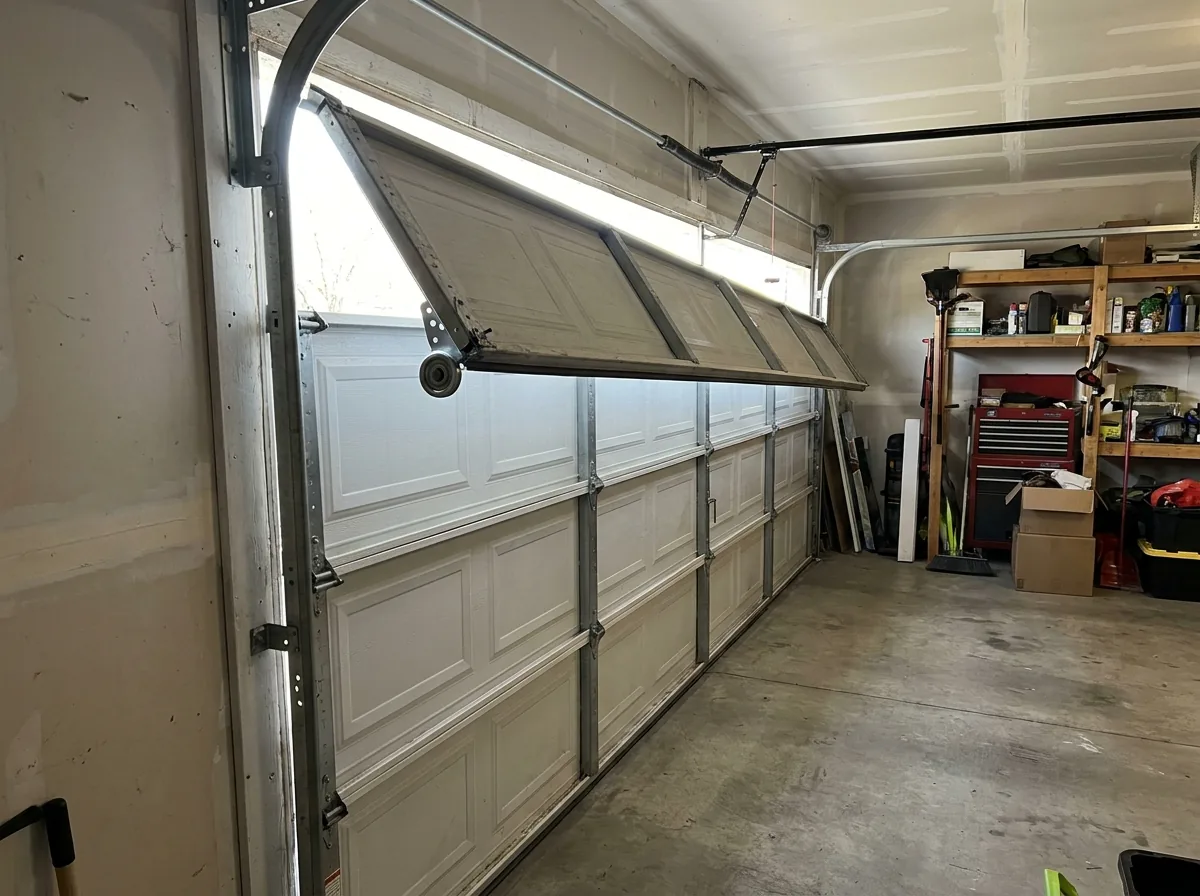
Open the door partway, or fully, and look at the inside face of the sections and the end stiles, the vertical edges of each section. The label is usually on the back of the top or bottom section or on an end stile, sometimes on a sticker near the track. On an older door it may be faded, painted over or gone.
A rating label carries some or all of these:
- Manufacturer and model. The series name and the section design.
- Size. The width and height the rating was tested at.
- Design pressure. Two numbers, positive and negative, in psf.
- Approval number. An FL number for a Florida Product Approval, or an NOA number, which looks like a two digit year, a four digit date and a two digit suffix, for a Miami-Dade Notice of Acceptance.
- Impact. The word impact, the words large missile, or a reference to the impact test standard. If none of those appear, the door is wind rated only.
- Date of manufacture.
If you find a design pressure and an approval number, the door is rated, and the approval number tells you which system. If you find a label with only a model name and a date, or no label at all, treat the door as unrated. The statewide Florida Building Code took effect in 2002, and many doors installed before then outside South Florida were never rated.
What the label does not tell you
A label proves what the door was when it left the factory. It does not prove how it was installed. The rating assumes the struts on the drawing, the fixings on the drawing, and the track and jamb the approval calls for. A rated door screwed into a rotted wood jamb, or fitted without its top strut because the installer was in a hurry, is not the door on the label. That is what the permit inspection exists to catch, and our guide to garage door permits in Florida explains what the inspector looks at.
It also does not tell you how the door has aged. Thirty years of salt air on a rated door in Kendall or Hollywood leaves rusted stiles, thinned bottom sections and fixings that have lost their grip. The rating does not decay on paper. It decays in the steel, and our guide to rust and Florida humidity shows what that looks like.
The insurance side
Florida’s wind mitigation inspection, on form OIR-B1-1802, records whether openings, including the garage door, have rated protection. A rated door may qualify for a premium credit under the state’s mitigation discount rules; the schedule is your insurer’s, and you should ask them for it before you buy, along with what the inspector needs to see on the garage door. Our guide to the wind mitigation insurance credit covers the form. We do not promise a dollar figure.
What each costs
| Door | Florida, installed |
|---|---|
| Wind rated steel single, FL approval | $950 to $4,200 |
| Hurricane rated door, impact rated or HVHZ NOA | $1,800 to $6,500 |
| Impact rated full view glass door | $8,000 and above |
| Permit | Included in the quote |
Both are starting prices for a standard single door, and both come with a one year parts and labor warranty on the invoice. Our hurricane rated garage door cost guide breaks down what moves the price, the prices page carries every starting price, and new door installation and hurricane rated door installation are quoted in writing with the approval number on the quote. The buyer’s guide compares the materials the rated versions come in.
Bracing is not an impact rating
Retrofit bracing kits add vertical posts to an existing door so it holds more pressure. They have Florida Product Approval in most of the state and are not the accepted route in the HVHZ. A braced door is a stronger door, and it is not an impact rated door: nothing about a post behind the sections stops a projectile going through them. Our guide to bracing kits covers when a kit is the right call and when a rated door is the honest answer, and if a storm has already been through, storm damage repair at $150 to $1,500 is where the assessment starts.
Related questions
What does design pressure mean on a garage door?
The wind pressure the door is rated to hold, in pounds per square foot, written as a positive number for wind pushing in and a negative number for suction pulling out. The required pressure for your site comes from the design wind speed, the exposure, the wall height and where the door sits on the wall, and the door on the permit has to meet it.
What is the large missile impact test?
A nine pound piece of two by four lumber is fired at the door at about 50 feet per second, then the door is cycled through thousands of rounds of positive and negative pressure to prove the impact did not open a path for the wind. A door that passes is impact rated. It stands in for the debris a hurricane throws.
Is every hurricane rated door impact rated?
No. Hurricane rated is a sales phrase. A door can be wind rated only, meaning it holds a design pressure but has not been impact tested. Look for the word impact or a reference to the impact test on the label, and ask for the approval number in writing.
Where is the rating label on my garage door?
On the inside face of a section, usually the top or bottom one, or on an end stile, the vertical edge of a section. Sometimes it is a sticker near the track. It should show the manufacturer, model, size, a positive and negative design pressure and an FL or NOA number. No label means treat the door as unrated.
Do I need an impact rated door in Miami-Dade or Broward?
The door there needs a Miami-Dade NOA, and the door we install in the HVHZ is an impact rated NOA door. Outside the HVHZ the door needs a Florida Product Approval, and whether impact is also required at your address is confirmed with the building department before we quote.
What does each cost?
A wind rated steel single installs for $950 to $4,200 in Florida. A hurricane rated door, impact rated or HVHZ NOA, installs for $1,800 to $6,500. Both include the permit and a one year parts and labor warranty.