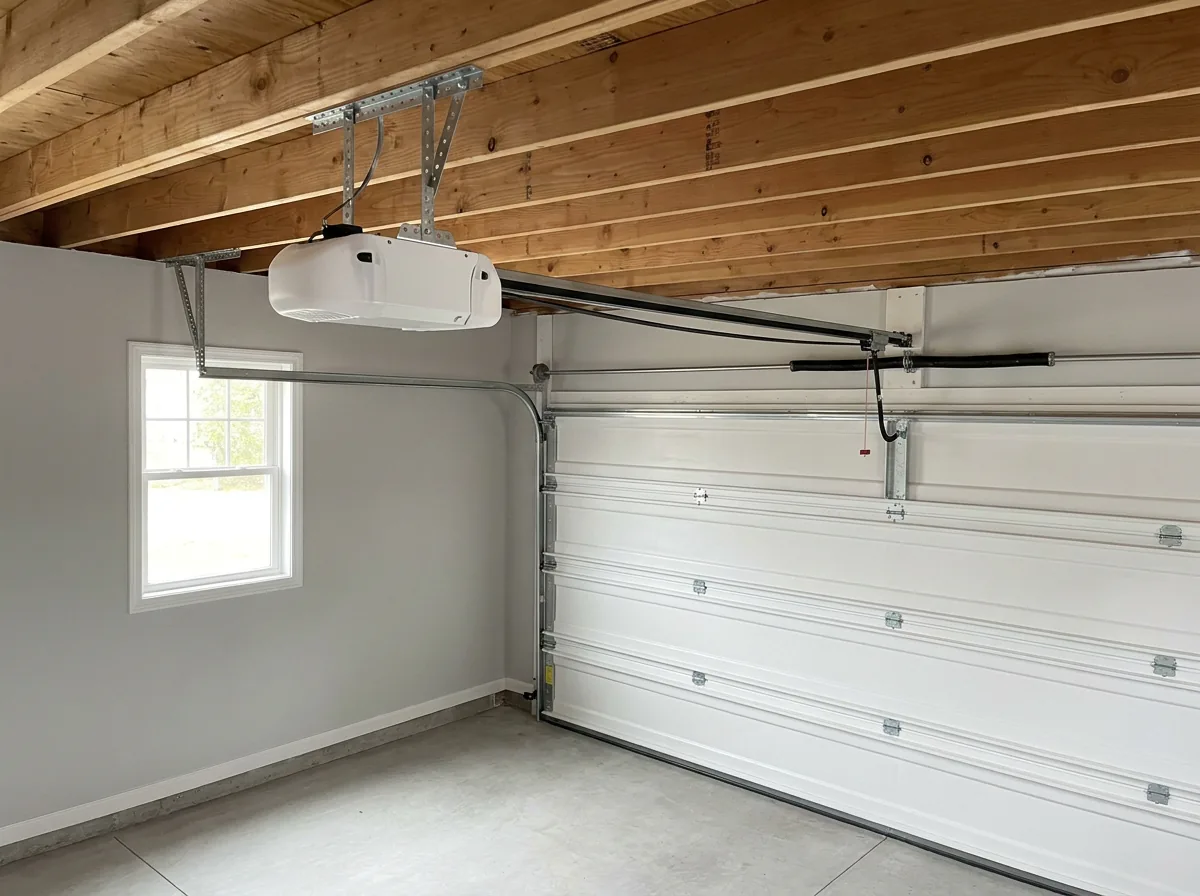
Garage Door Opener Light Blinking: What the Flashes Mean
On a LiftMaster or Chamberlain opener, a light that flashes 10 times when you press the button almost always means the safety sensors are blocked, misaligned or wired wrong. The door will go up and refuse to come down. Check the two photo eyes near the floor before anything else. Other flashing patterns are model specific and have to be read against your manual, and if it needs a technician, opener repair in Florida runs $95 to $300.
First, work out what is actually flashing
Three different things on a garage door system blink, and people mix them up constantly when they call us.
The opener light bulb, up in the motor unit. This is what people mean when they say “it flashed 10 times”. On most LiftMaster and Chamberlain units the light doubles as a diagnostic display.
The two sensor lights, down near the floor at each side of the door opening, about six inches up. One green, one amber on most units.
The LEDs on the motor unit itself, behind the lens cover on newer models. These are the real diagnostic codes, usually an up arrow LED and a down arrow LED that flash in a counted pattern.
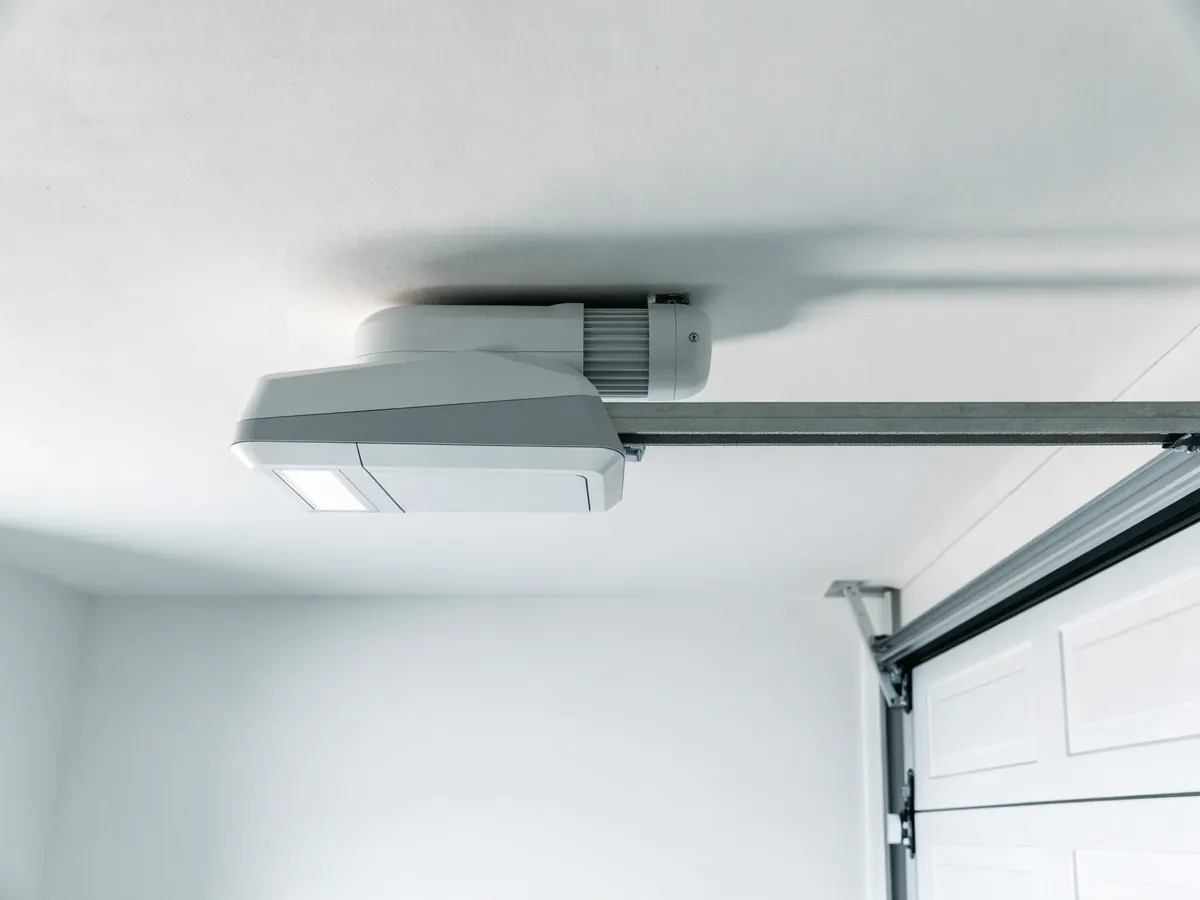
Which one is flashing changes the answer completely. Go and look before you read further.
Ten flashes means the safety sensors
On LiftMaster and Chamberlain openers, if you press the button to close and the opener light flashes ten times, the opener is telling you it cannot confirm a clear path. The door will go up perfectly happily and refuse to go down.
Work through this in order.
Is anything in the beam? A recycling bin, a bike wheel, a coiled hose, a broom that fell over. It takes very little and it is by far the most common cause.
Are the lenses dirty? In Florida that means more than dust. Ants walk across the lens, small lizards sit in the housing, and rain splashed in from the driveway leaves a film. Wipe both lenses with a dry cloth and look inside the hood.
Are they pointing at each other? Each sensor sits in a bracket that bends if anything knocks it. On most units the receiving eye shows a steady green light when it is aligned and unblocked. If that light is off or flickering, alignment is your problem. Loosen the wing nut, move the sensor slowly until the light goes steady, tighten it back up.
Is the sun in one of them? Direct low sun into the receiving lens washes out the infrared beam. If your garage faces west and the fault shows up in the late afternoon, that is the whole story, and unlike further north it happens all year here. A small shade above the sensor solves it.
Is the wire damaged or corroded? The sensor wire runs along the wall at floor level. That is where it gets stapled through, pinched behind shelving, chewed, and, in Florida, where storm water sits against it. Look at the small screw terminals on the back of each sensor. Green or white crust on them means corrosion, and a connection that comes and goes with the humidity is the classic Florida sensor fault.
If all five check out and the flashing continues, the sensor pair or the logic board has failed. That is where you stop and call someone. Our guide on safety sensors has more on how they work.
What the sensor lights themselves tell you
The sensor LEDs are more useful than the opener light because they narrow the fault down to one side.
Both lights steady. Sensors are fine. Your problem is somewhere else, most likely the down travel limit or the force setting. Our guide on a door that closes then reopens covers those.
Sending eye lit, receiving eye dark or flickering. Alignment or a blocked beam. The transmitter has power and is working, the receiver is not seeing it.
Neither light on. No power reaching the sensors at all. Usually a broken, disconnected or corroded wire, occasionally the logic board.
A light that changes when you wiggle the wire. You have found your fault. It is the wire.
The counted codes on the motor unit
Newer LiftMaster and Chamberlain units have two small LEDs on the motor head, an up and a down, that flash in a counted pair. You read it as a two part code: the up LED flashes a number of times, then the down LED flashes a number of times.
Here is the honest position on those codes. The mapping is model specific, and it changed between generations of boards. Publishing a confident table of every code and every meaning would be inventing precision that does not exist across the whole range, and a wrong code sends you buying the wrong part.
What you should do instead. Find the model number on the sticker on the side or back of the motor unit. Look it up against the manufacturer’s diagnostic chart, which LiftMaster and Chamberlain both publish free. Count carefully and count twice, because people routinely report nine flashes as ten, or read a pause as part of the pattern.
Two patterns are common enough across the range to be worth knowing. Anything where the up LED flashes once is almost always sensor related, and matches the ten flash behaviour above. Anything where the up LED flashes four times tends to point at the travel limits, meaning the opener has lost its sense of where the floor is. A power outage mid travel, which Florida storms hand out regularly, is a common way for that to happen, and on many units a full open and close cycle clears it.
Genie and other brands read differently
Genie units do not use the same scheme. Many Genie models put the diagnostic on a small LED near the wall console or on the powerhead, and the meanings do not map onto the LiftMaster numbering at all. Linear, Overhead Door, Wayne Dalton and Sommer all have their own schemes. Craftsman units were built by Chamberlain for years and often follow its codes, but check the model.
Faults, checks and costs
| What you see | What to check | What it costs |
|---|---|---|
| 10 flashes, door goes up not down | Beam blocked, lenses, alignment, afternoon sun | Nothing if you clear it yourself; realignment is part of a tune-up at $85 to $160 |
| Receiving light flickers with humidity | Corroded terminals or a wet wire run | Opener repair $95 to $300, the sensor pair is a cheap part |
| Neither sensor light on | Wire cut or disconnected, or no power from the board | Opener repair $95 to $300 |
| Up LED flashes four times | Travel limits lost, often after an outage | Limits reset, part of a tune-up or opener repair |
| Codes come and go on hot afternoons, unit over ten years old | Logic board failing from heat | Opener repair if the board is available; new opener $275 to $600 if not |
| Codes clear but door is heavy by hand | Fatiguing spring, not the opener | Spring replacement $150 to $350 per spring |
Every price is a starting price for a standard single door, with the full list on our prices page.
What you can fix yourself and what you should not
Fix yourself, comfortably. Clearing the beam, cleaning the lenses, realigning a sensor, shading a sensor from the sun, replacing a corroded length of sensor wire, changing the opener bulb.
Leave alone. Adjusting travel limits and force settings past a small correction, opening the motor head, or replacing a logic board. Force settings are a safety system, not a convenience setting. Turning the down force up until the door stops reversing is the single most dangerous thing a homeowner does to a garage door.
Never touch. The springs. Nothing about a flashing light should ever lead you to a torsion spring.
When the flashing is not the real problem
A door that has become heavy will trip the force protection, and the opener reports it as a fault when the real problem is a fatiguing spring. The test takes thirty seconds: pull the manual release, lift the door by hand to waist height and let go. A balanced door stays roughly where you left it. A door that drops or fights you has a spring problem.
Heat is the other one. A logic board in a garage that spends every summer above 100°F ages faster than the same board anywhere else in the country, and an opener past ten or fifteen years that throws intermittent codes on hot afternoons is often the board itself failing rather than anything the code names. Boards for discontinued models get scarce and expensive, and at some point the sensible number is a new opener rather than a third repair on an old one. Our guide on an opener that has quit covers that decision. We will tell you which side of that line you are on before you spend anything, in Orlando, Tampa or anywhere else in the state.
Related questions
What does it mean when my garage door opener light flashes 10 times?
On LiftMaster and Chamberlain units it means the safety reversing sensors are not seeing each other. Something is blocking the beam, the sensors have been knocked out of alignment, or the wire running to one of them is damaged or corroded. The door will open normally and refuse to close, which is the behaviour the flashing is trying to explain.
Why does the door open fine but not close?
Because the safety sensors only govern closing. An opener will always let a door go up, since a door going up cannot trap anyone underneath it. If your door goes up and refuses to come down, look at the sensors before you look at anything else.
Can I just disconnect the safety sensors?
No. Federal law has required them on every residential opener sold in the United States since 1993, and they exist because garage doors have killed children. You can hold the wall button down continuously to close the door once in an emergency. That is a way to secure your garage tonight, not a repair.
The sensor lights look fine but the opener still flashes. Now what?
Sensor lights can look normal while the wire behind them is damaged, or while one sensor has failed internally. The wire runs along the wall at floor level, which is exactly where it gets stapled through, pinched, chewed, or sits in storm water. If the wiring and alignment both check out, the sensor pair or the logic board is the next suspect and that is a service call.
Why does it only flash in the late afternoon?
Low sun into the receiving eye. A garage that faces west gets direct sun across the sensor in the last hours of the day, and in Florida that happens all year rather than in one season. A small hood over the receiving sensor, or swapping the sensors so the receiver is on the shaded side, solves it.
Do intermittent codes mean I need a new opener?
Not on their own. Clear the sensors and the wiring first. But an opener past ten or fifteen years that throws random codes on hot afternoons is often a logic board aging in the heat, and if a board for that model is scarce, a new opener at $275 to $600 is usually the better spend than a board that costs more than half of that.