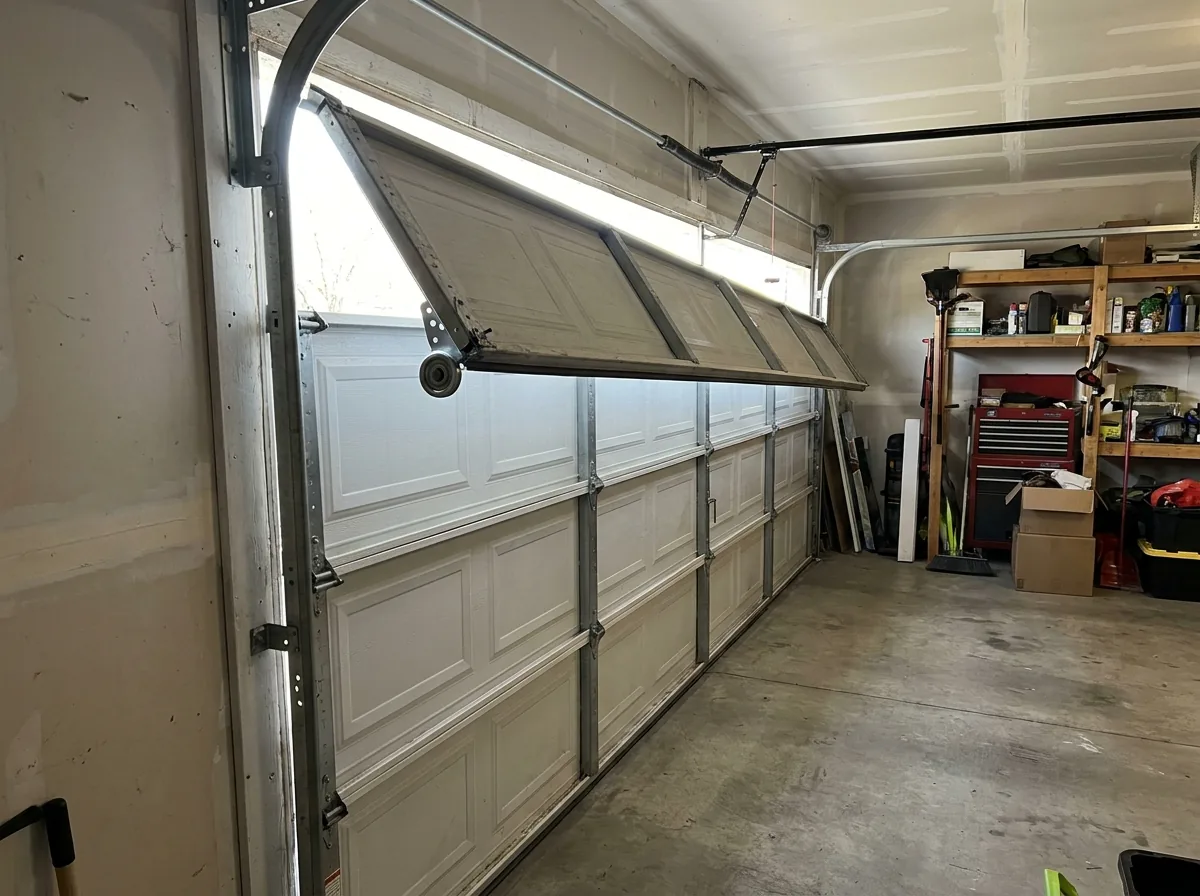
Garage Door Making Noise: What Each Sound Means in Florida
Grinding usually means a rusted or dry roller bearing. Squealing means dry hinges or rollers, which Florida humidity and heat bring on faster than anywhere else. A single bang is a spring or cable letting go. Popping is section hinges binding. Rattling is loose hardware. Most noise is silenced by a tune-up at $85 to $160, and most of it gets expensive if ignored.
Match the sound to the cause
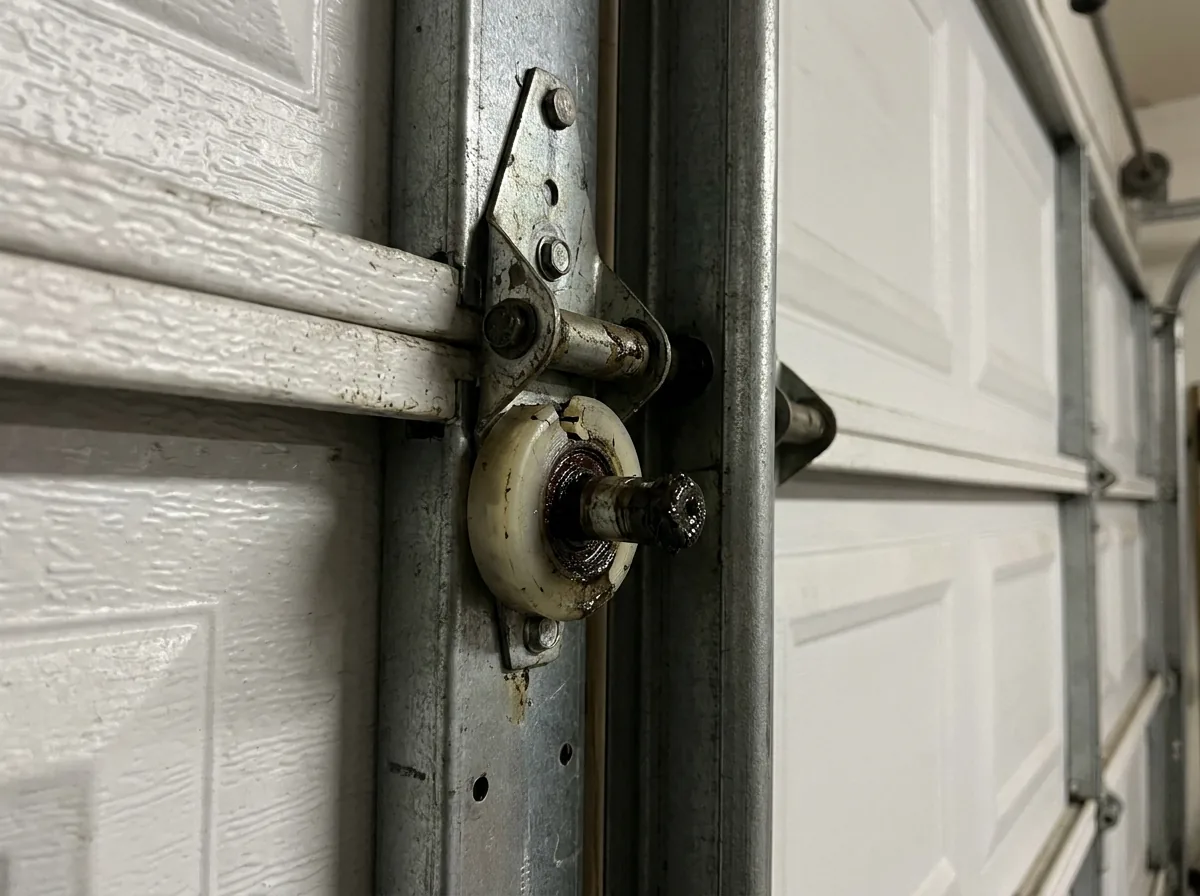
Grinding. Metal on metal without lubrication. Most often a roller bearing that has rusted or run dry and is sliding in the track rather than rolling. Sometimes a worn end bearing plate on the torsion shaft. Both are cheap now and expensive later.
Squealing or screeching. Dry hinges and rollers. This is the noise that responds best to lubrication, and it is the most common reason people book a tune-up.
A single loud bang. A spring or a cable letting go. If the door then will not open, it is the spring. Stop using the opener. Our guide on a loud bang from the garage door covers what to do next.
Popping or snapping on the way up. Section hinges binding as the door articulates around the curve of the track. Usually dry hinges, sometimes cracked ones, occasionally a door that is out of square.
Rattling. Loose hardware. A garage door vibrates every time it runs, bolts work loose over years, and in a block wall the lag bolts holding the track brackets can loosen as well. Tightening everything takes twenty minutes and prevents a surprising amount.
A rumble you feel through the wall. Chain drive noise transmitted into the structure. This is not a fault, it is what chain drives do.
Straining or humming with no movement. The motor is powered but something between it and the door has failed: a stripped gear kit, a broken trolley, or a door so out of balance the opener cannot lift it. Our guide on an opener that runs but the door does not move covers that one.
Why Florida doors get loud
Three things here work against quiet hardware.
The first is humidity. A hinge pin or a roller bearing that would stay lubricated for two years in a dry climate rusts in one here, and once there is rust in the bearing the roller stops rolling and starts scraping. Within a few miles of the coast, salt air makes that faster again.
The second is heat. A garage that sits above 100°F all summer thins out spray lubricant and dries it faster, so a door lubricated in the spring can be squealing by August.
The third is use. A Florida garage door is the front door, the door to the storage and the door to the workshop. In golf cart communities it can cycle several times a day. More cycles means more wear on every moving part, and a door that runs four times a day reaches the point where it needs attention twice as fast as one that runs twice. Our guide on summer heat problems covers the rest of what the season does.
The five minute check
With the door closed, pull the manual release and move it by hand.
If it is quiet by hand and loud with the opener, the noise is the opener.
If it is loud by hand, walk the door slowly and listen. You can usually put a finger on the exact roller or hinge making the sound. Look for rust streaks below a hinge, a roller that does not turn when the door moves, or a hinge with a crack at the knuckle.
What to lubricate, and what not to
Use a garage door silicone or white lithium spray. Not WD-40, which is a solvent and displaces the lubricant that is already there, and not grease, which collects sand.
Do lubricate: hinge pivot points, roller bearings, the torsion spring itself, the end bearing plates if it is a chain or screw drive.
Do not lubricate: the track. Track needs to be clean and dry. Grease in the track collects the sand and grit that blows into every Florida garage and turns it into an abrasive paste that wears rollers faster than no lubricant at all.
Do it twice a year. The best times are March to May, before the season, and again after hurricane season ends in November. Our step by step on how to lubricate a garage door has the full sequence.
Sounds, causes and costs
| Sound | What to check | What it costs |
|---|---|---|
| Squealing | Dry hinges and rollers, lubricant thinned by heat | Lubrication and adjustment in a tune-up, $85 to $160 |
| Grinding | Rusted or seized roller bearing, worn end bearing plate | Tune-up plus a roller set or bearing, quoted as parts |
| Popping on the curve | Binding or cracked section hinges | Hinges replaced on the same visit, quoted as parts |
| Rattling | Loose hinge bolts, loose track brackets in the block | Tightened during a tune-up |
| Single bang, door now heavy | Broken torsion spring | Spring replacement $150 to $350 per spring |
| Single bang, door now crooked | Snapped or slipped cable | Cable repair $95 to $300 |
| Rumble through the wall | Chain drive vibration into the framing | Isolation mounts, or a belt drive opener at $275 to $600 |
| Humming, no movement | Stripped gear, failed capacitor, or a heavy door | Opener repair $95 to $300 |
Every price is a starting price for a standard single door, and the full list is on our prices page.
Opener noise into the house
Almost every Florida house is single story with the garage attached, which means a bedroom or a living room shares a wall with the opener. A chain drive bolted to the ceiling joists sends its vibration straight through that wall.
If the door hardware is quiet by hand and the noise is the opener, you have two options. Rubber isolation mounts between the motor unit and the ceiling take some of it out. A belt drive takes almost all of it out, and if the opener is over ten years old and has spent those years in a hot garage, replacing it is often the better spend than quieting it. Our guide on belt versus chain drive compares them.
When to call
Call when the noise is grinding rather than squealing, when there is a new noise at one specific point in the travel, when the door has started running crooked, or when lubrication has stopped helping.
A tune-up at $85 to $160 covers the inspection, the lubrication, the hardware tightening and the limit and balance adjustments. Parts found and replaced are quoted separately, and we show you the part we took off. Our guide on tune-up cost lists what should be included. We work statewide, from Southwest Florida to North Florida, same day, seven days a week.
Related questions
Is a noisy garage door dangerous?
Not immediately, but it is a warning. Almost every expensive garage door failure has a noisy phase before it. A grinding roller that seizes takes the door off the track; a rattling bolt that falls out drops a hinge; a spring that has started to creak is usually close to its cycle limit.
Which lubricant should I use?
A garage door specific silicone or white lithium spray on hinges, rollers, springs and bearings. Not WD-40, which is a solvent and displaces the lubricant that is already there, and not grease, which collects the sand that blows into every Florida garage. Never lubricate the track: it should be clean and dry.
How often should I lubricate a garage door in Florida?
Twice a year. Once between March and May before the wet season, and once after hurricane season ends in November. Heat thins spray lubricant and humidity rusts anything it leaves bare, so a door lubricated once a year is usually squealing again by August.
Will a new opener make my door quieter?
Only if the noise is coming from the opener. Pull the manual release and run the door by hand. If it is quiet by hand and loud on the opener, a belt drive will fix it. If the door itself is loud, a new opener changes nothing and the money belongs in rollers, hinges and a tune-up.
Why is my door louder in the summer?
Heat and humidity. A garage over 100°F dries out the lubricant on hinges and rollers, and the humidity puts a film of rust on whatever is left bare. Add the daily cycling of a Florida garage door and by August a door serviced in the spring can be squealing again.