Loud Bang From the Garage: What Just Broke
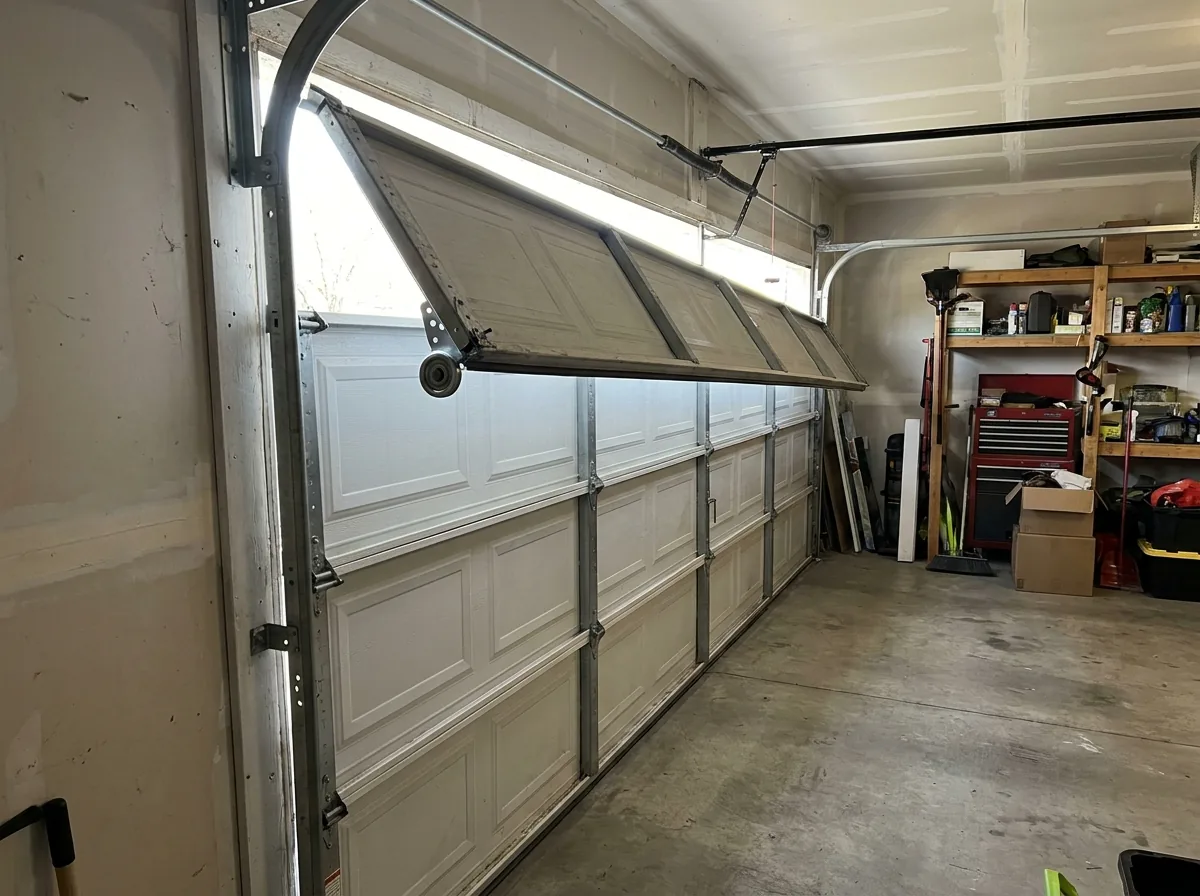
A single loud bang from the garage, followed by a door that will not open, is almost always a torsion spring snapping. The sound is the spring releasing its stored energy against the shaft. Do not use the opener: the springs carry the weight of the door, and without them the opener will strain, crease panels, or drop the door. Spring replacement is $150 to $350 per spring installed, and replacing both on a two spring door adds $120 to $250.
What you heard
People describe it as a gunshot, a car hitting the house, or something heavy falling over in the garage. It is loud, singular, and it comes from the garage, often at 6 in the morning when the door is first used or during an afternoon storm when everyone assumes it was thunder.
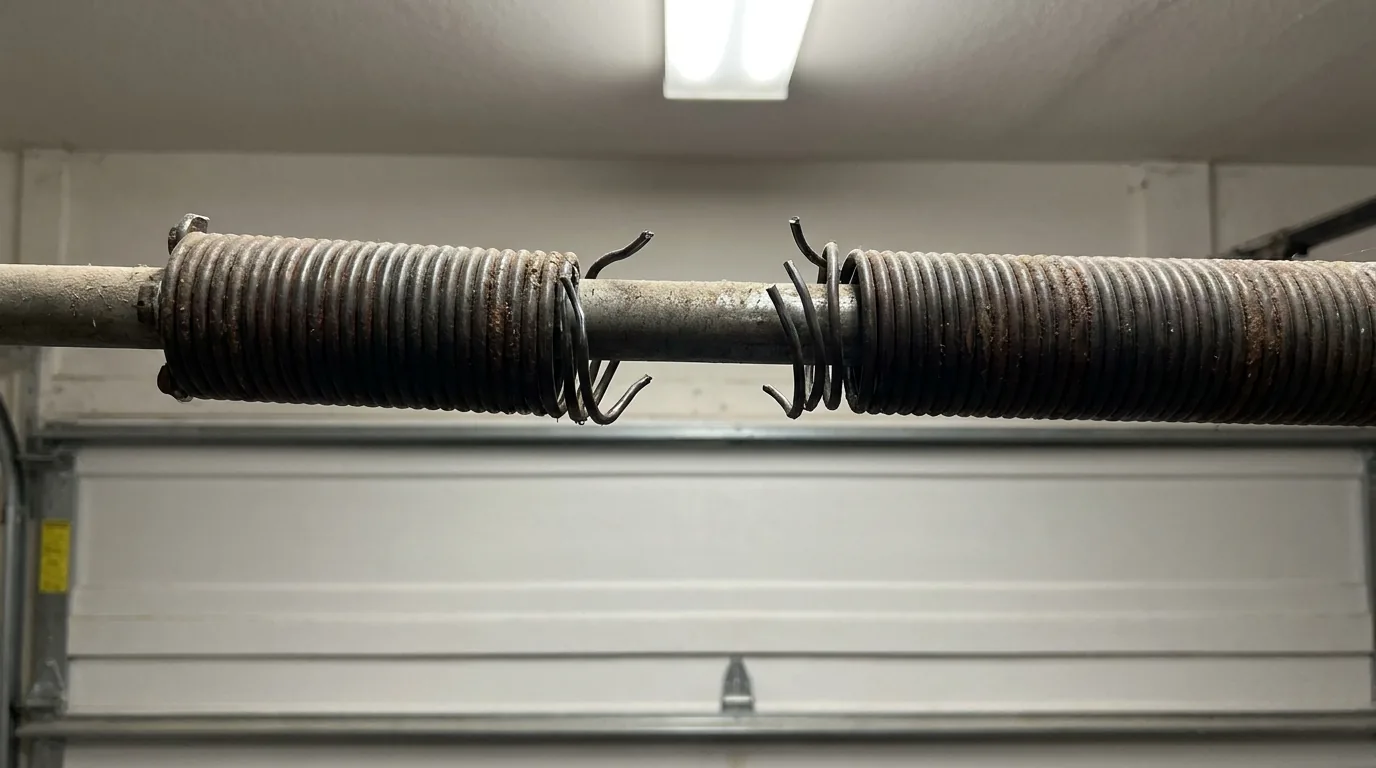
What happened is that a wound torsion spring, holding a couple of hundred pounds of stored energy, reached the end of its cycle life and let go. The energy discharges against the shaft in a fraction of a second. The gap in the coil is usually visible from the floor: a clean break with the two halves separated by an inch or two.
The next ten minutes
Do not press the opener button. The springs lift the door, not the motor. Running the opener now will strain the motor, strip the gear, crease the top section, and can pull the door off the track. Every press makes the repair bigger.
Look at the spring. It runs along the shaft above the door opening. A broken one has an obvious gap. If you can see that gap, you have your answer. If you have extension springs, which run alongside the horizontal tracks on many older single doors in Hialeah, Hollywood and St. Petersburg, a broken one is stretched, snapped or hanging.
Leave the door where it is if it is closed. This is the good outcome. Your car may be trapped, but nothing is going to get worse overnight, and the house is secure.
If the door is open, be careful. Without spring support it is dead weight, 130 to 350 pounds depending on the door. Two people can usually bring it down slowly with hands flat on the bottom section and clear of the joints.
Do not pull the manual release with the door up. Pulling the release on a raised door with a broken spring lets it drop.
If you need the car tonight, our guide to a car trapped in the garage walks through the safe order of operations, and what to do when a spring breaks has the full checklist.
What else makes a bang
Most of the time it is the spring. These are the others, and how to tell.
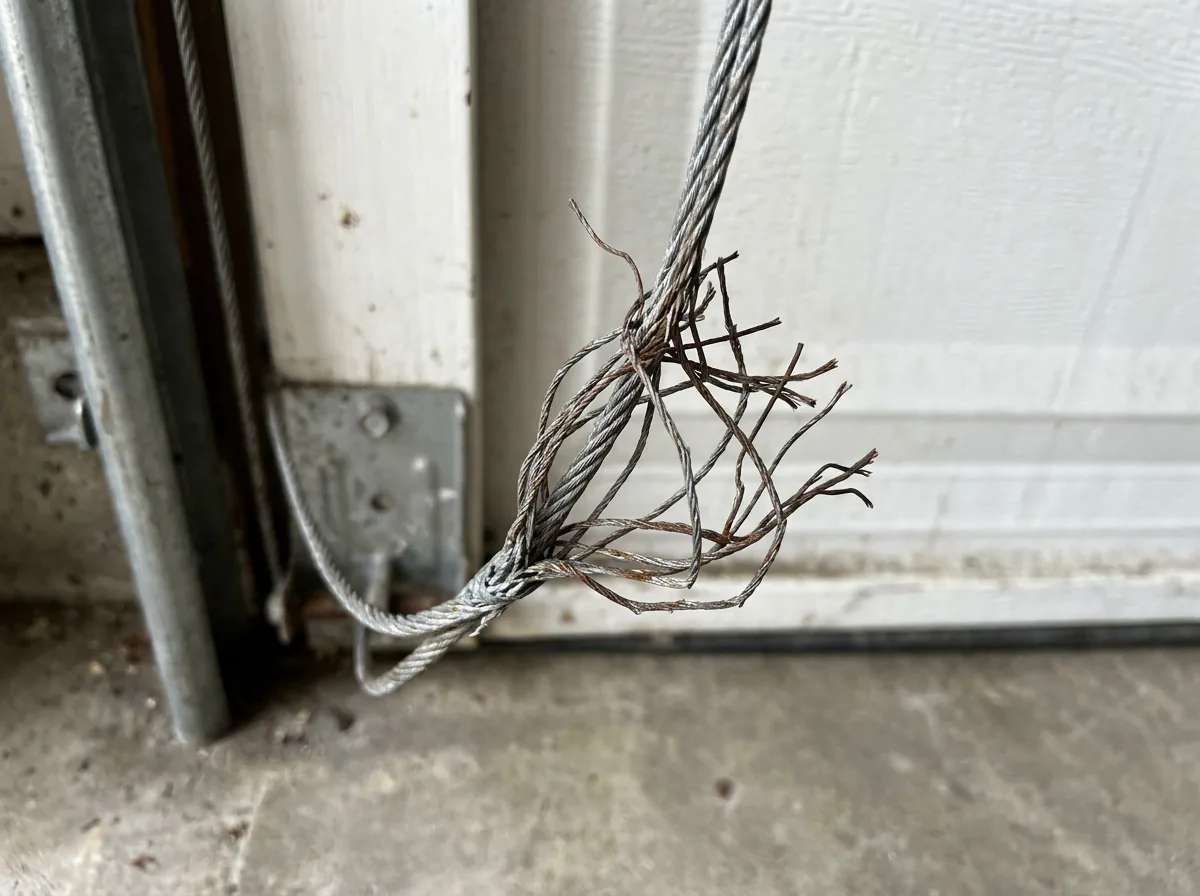
A lift cable snapping. A sharper, lighter crack. The door drops on one side, hangs crooked, and may jam in the tracks. Rust on a cable is the most common visible warning we see in Florida, and a rusted cable frays strand by strand until it goes. Cable repair runs $95 to $300, or $225 to $400 with the drum.
The opener header bracket tearing out. The bracket that holds the opener rail to the wall above the door pulls its lag bolts out of the header, often because the door was already heavy and the opener had been fighting it. The rail drops and hangs. This happens on older CBS houses where the bolts went into a wood buck that has softened with humidity.
A roller jumping the track. A bang followed by the door sitting crooked or leaning out of the track on one side. That is an off-track repair from $140, and our guide to a door off its track explains why you should not touch it.
Thunder, a transformer, or a neighbor’s shutters. In a Florida summer, a bang during a storm has plenty of candidates. The test is simple: try the wall button the next morning. If the door opens normally, it was not the door.
What it costs to fix
| What broke | How to tell | What it costs |
|---|---|---|
| One torsion spring | Gap in the coil, door will not lift | $150 to $350 per spring installed |
| Both springs together | Two spring door, one broke | Adds $120 to $250 to the single spring price |
| Lift cable | Sharp crack, door crooked | $95 to $300; $225 to $400 with drum |
| Cables replaced with the springs | Rust on the cables at the same visit | Quoted with the spring job |
| Door off track | Door leaning out of the track | $140 to $600 off-track repair |
| Panel creased by running the opener | Top section bent at the bracket | $250 to $800 per section |
| Same-day or after-hours dispatch | Car trapped, door open, storm inbound | $150 to $300 on top, stated before dispatch |
Every figure matches our prices page and is a starting price for a standard single door in normal condition. A 16 foot double door with two springs is quoted in writing before we start.
Whether this is an emergency depends on your situation. Door closed, car outside, and it can wait until morning, which saves you the premium. Car trapped and needed, door stuck open on an attached house, or a tropical storm watch posted and a door that cannot be closed, and it cannot wait. Emergency repair is a $150 to $300 premium on top of the repair price, and we say the number before the truck leaves.
Both springs, and why
If your door has two springs, they were installed together and have taken the same number of cycles. The one that did not break is at the same point in its life as the one that did, and in practice it usually follows within a few months.
Replacing both at once adds $120 to $250 rather than doubling the price, because the visit and most of the labor are shared. It is one of the few recommendations in this trade that is arithmetic rather than sales.
You can decline it. A company that will not let you decline it is telling you something.
Why springs break in Florida
Springs fail on cycles, not on age alone, and never on cold here. A standard spring is rated for about 10,000 open and close cycles, which is seven to ten years for a light user. A Florida family door cycles six to ten times a day because the garage is the storage room and the second front door, and that reaches 10,000 in five to seven years. In golf cart communities like The Villages the count climbs just as fast.
Humidity and salt air pit the surface of the coil, and a pit is where the crack starts. Within a few miles of either coast we replace springs that are visibly rusted at five and six years old. How long garage door springs last has the numbers by usage, and high cycle springs explains the 25,000 cycle option that makes sense for a busy door.
Why it is not a DIY job
A torsion spring is wound to a specific number of quarter turns for the weight of your specific door. Winding and unwinding it takes proper winding bars, and doing it with a screwdriver is how people lose fingers and take blows to the head.
This is not caution for its own sake. It is the single most common serious injury in residential garage door work, and it happens to competent people who underestimated the amount of energy involved. Read why never DIY a torsion spring before you search for a video.
Where we are
Same-day spring replacement seven days a week across Miami-Dade County, Broward County, Palm Beach and the Treasure Coast, Tampa Bay, Central Florida, Southwest Florida and North Florida. Call (561) 897-9930, tell us the door width and whether you can see one spring or two, and we bring the right ones on the first trip.
Related questions
Is a broken spring dangerous once it has snapped?
The spring itself has released its energy and is no longer under tension. The danger is now the door, which is dead weight with nothing holding it up. Do not stand under it, do not pull the manual release with the door raised, and do not lift it without a second person and something to prop it.
Could the bang have been something else?
A cable snapping makes a sharper, lighter crack and usually leaves the door crooked rather than immovable. An opener bracket tearing out of the header makes a bang and leaves the rail hanging. Thunder and a transformer blowing are the two things people confuse it with during a Florida storm. A bang with the door then refusing to lift is the spring in the large majority of cases.
Why did my spring break now, in the summer?
Springs fail on cycles, not on weather. A standard spring is rated for about 10,000 open and close cycles, and a Florida door reaches that count early because the garage is the front door of the house. Humidity and salt air pit the coil, and the crack starts at a pit. Summer is simply when doors cycle the most.
Do I need to replace both springs?
If the door has two springs, we recommend it. Both were installed on the same day and have the same cycle count, and the survivor usually follows within months. Doing both at one visit adds $120 to $250 rather than doubling the price. You are free to decline it, and we will tell you what a return visit costs.
Is this an emergency call?
It depends on your situation. Door closed and the car is outside: it can wait until morning and you save the $150 to $300 emergency premium. Car trapped and needed, door stuck open, or a storm on the way and the door will not close: it cannot wait, and we say the premium before we dispatch.