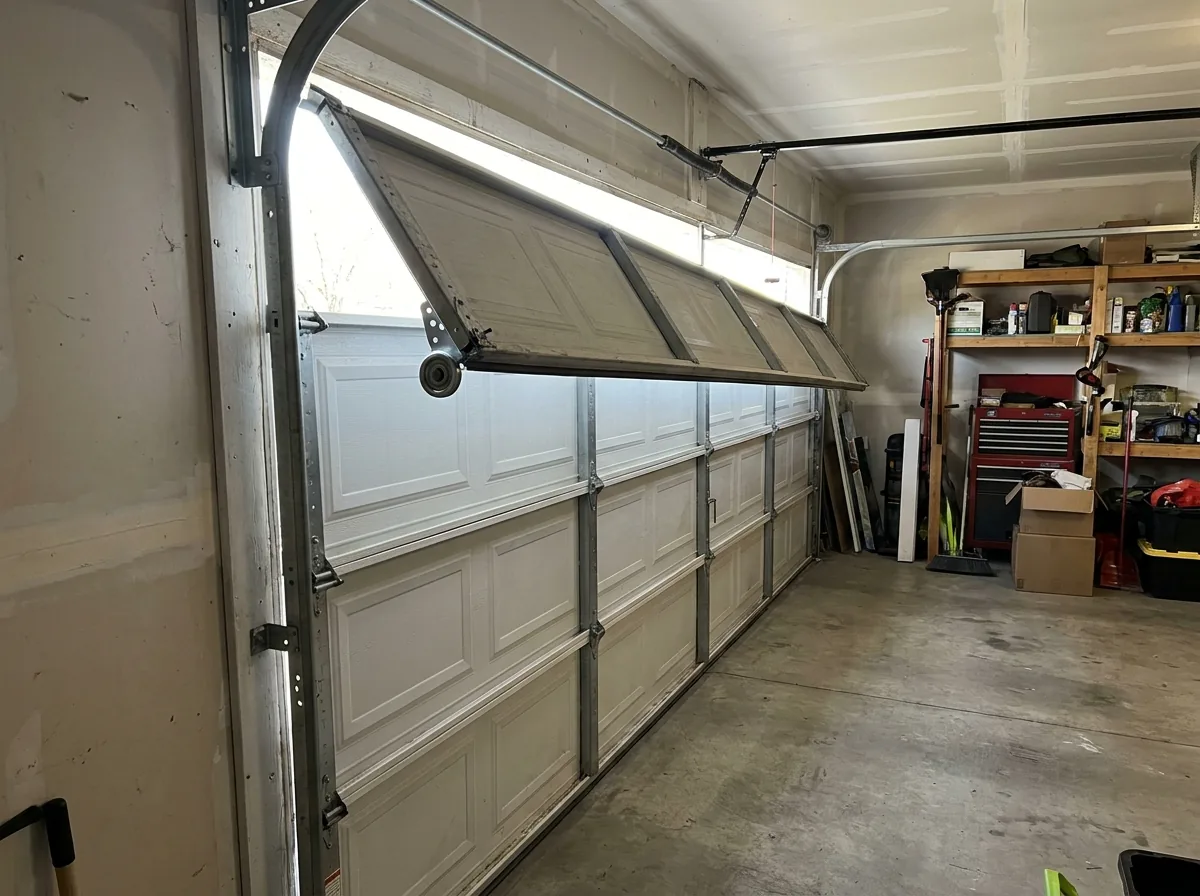
Garage Door Roller Replacement in Florida: When and What Kind
Garage door rollers need replacing when they no longer spin freely, when the wheel is worn flat or chipped, or when the stem is bent. In Florida the right replacement is a nylon roller with sealed bearings, because it does not rust in salt air and does not pack with sand and grit. We usually replace a full set during a tune-up, which costs $85 to $160 plus the rollers as a parts line on the written estimate.
Rollers are the part of a garage door most people never think about until the door starts to scream every time it moves. In Florida they wear faster than the manufacturer expects, because the garage is 100°F for a third of the year, the air is wet, the driveway is sandy, and near either coast the air is salty. This is what to look for, what to replace them with, and the one check that has to happen first.
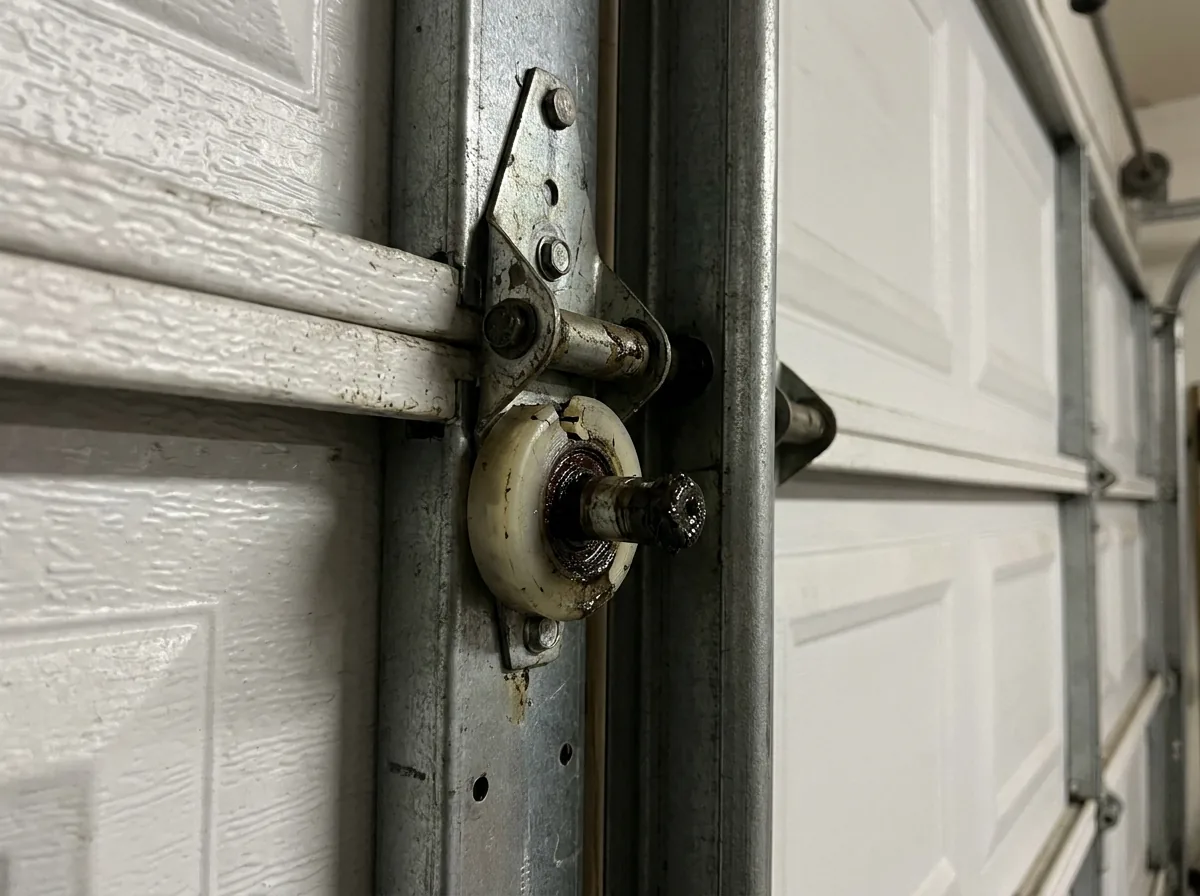
How to tell they are done
Close the door, pull the red manual release to disconnect the opener, and spin each roller by hand.
It should turn freely and quietly. A roller that will not turn is sliding along the track rather than rolling. It wears a flat spot on the wheel, wears a groove in the track, and drags the whole door so the opener works harder than it should.
Look at the wheel. A worn roller has a flattened or chipped edge, a nylon wheel that has cracked, or visible play where the wheel meets the stem.
Look at the stem. A bent stem means the roller has taken a side load. That usually means the track or the cables need looking at too, which is the subject of the section below.
Look at the bearing. On a steel roller with an open bearing, rust in the ball race is what you will find near the coast. On a canal lot in Cape Coral or a street east of US 1 in Fort Lauderdale we see bearings seized solid in four years.
Listen. A grinding noise that follows one point on the door as it travels is a roller bearing. A squeal on every cycle that goes away for a week after lubricating is a roller that is on its way out. Our guide on why a garage door makes noise covers the other sounds.
Types compared
| Type | Typical life in Florida | Noise | Salt air |
|---|---|---|---|
| Steel wheel, open bearings | 4 to 7 years | Loudest | Bearing rusts and seizes |
| Nylon wheel, no bearings | 6 to 10 years | Quieter | Wheel is fine, stem can rust |
| Nylon wheel, sealed bearings | 10 to 15 years | Quietest | Best available |
| Nylon, sealed bearings, stainless stem | 10 to 15 years | Quietest | Specify near the coast |
Sealed bearing nylon is the specification worth asking for. The bearing is protected from grit and water, which is what kills the cheaper types, and the wheel cannot corrode. Near the coast, ask for a stainless steel stem as well, because a rusted stem is the next thing to fail once the wheel problem is solved.
Cheap nylon rollers with no bearings at all are sold as an upgrade and they are not one. They are quiet for a year and then the wheel wears out from friction on the stem.
Why Florida is hard on rollers
Heat. Grease in an open bearing thins and runs out at garage temperatures over 100°F. Once the bearing is dry, it wears fast.
Sand and grit. Sandy soil across the state, agricultural dust around Homestead and Apopka, and construction dust in any new subdivision all end up in the track. An open bearing picks it up and grinds on it. Lubricant on the track makes this worse, not better, because it turns the grit into an abrasive paste.
Humidity and salt. A steel bearing that never dries out rusts, and salt air speeds that up. This is why the same roller lasts seven years in Lakeland and four in Venice.
Cycle count. Florida doors are the front door. A family running the door eight times a day puts more travel on a set of rollers in three years than a twice a day garage does in twelve.
Do not replace rollers without checking the track
This is the mistake that wastes the money.
If the track is bent, spread, or out of alignment, it is forcing the rollers to run at an angle. New rollers in a bad track wear out exactly as the old ones did, only faster, because they are being asked to do the same impossible thing.
A proper roller replacement includes sighting both tracks along their full length, checking every bracket is tight into the jamb, confirming the two tracks are the same distance apart top and bottom, and correcting the alignment before the new rollers go in. On a door that has already come off, that is off-track repair at $140 to $600 rather than a roller job.
After a storm, a bent lower track is common, and rollers are often blamed for a door that is actually riding a kink. Our guide on what to do after garage door storm damage covers that check.
What we do and what it costs
Roller replacement is normally part of a garage door tune-up, which is $85 to $160. The rollers themselves are a parts line on the written estimate, and a full set of sealed nylon rollers is one of the cheapest genuinely worthwhile upgrades on the whole door. Where we quote labor by the hour instead, it is $45 to $120 per hour. We do this across the state, from Southwest Florida to Palm Beach and the Treasure Coast.
A tune-up with new rollers includes the track check above, the hinges, the balance test, and lubrication of the new bearings. If we find the track is the real problem, we say so before we fit anything.
What not to touch
The bottom rollers sit in the bottom brackets at the two lower corners of the door. Those brackets anchor the lift cables and are under full spring tension even when the door is closed. Undoing a bottom bracket bolt with the springs wound is how people lose fingers.
Replace the middle rollers yourself if you want to, one at a time, with the door closed and the opener disconnected. Leave the bottom pair to us. Our guide on why you should never work on a torsion spring yourself covers the same principle for the rest of the tension system.
Every price on this site is a starting price for a standard single door, and you get a written estimate before any work begins. The full list is on our prices page.
Related questions
How long do garage door rollers last in Florida?
Steel rollers with exposed bearings typically last five to seven years inland and less near the coast, because the bearing rusts from the inside and seizes before the wheel wears out. Nylon rollers with sealed bearings last ten to fifteen years in the same garage. Heavy use shortens both, and Florida doors cycle hard.
Are nylon rollers worth the extra?
Yes, and more so here than most places. They are quieter, the wheel cannot rust, the sealed bearing keeps salt and sand out, and they last about twice as long. The difference across a full set is modest and the door is noticeably quieter the same afternoon.
Can I replace garage door rollers myself?
The middle rollers, with care and the door secured and the opener disconnected, yes. The bottom rollers sit in the bottom brackets, which anchor the lift cables and carry full spring tension even when the door is closed. Leave those to us.
Why is my door still noisy after new rollers?
Either the track is bent or out of alignment and the new rollers are being forced to run at an angle, or the noise was never the rollers. Dry hinges, worn end bearings on the torsion tube and a chain drive opener all sound similar from the driveway. A tune-up sorts out which it is.
How many rollers does my door have?
A standard four section door has ten rollers, two per section plus two at the top. A five section door, common on 8 foot tall doors in newer three car garages, has twelve. Some doors have a doubled roller at the top corner, which brings the count to eleven or twelve.