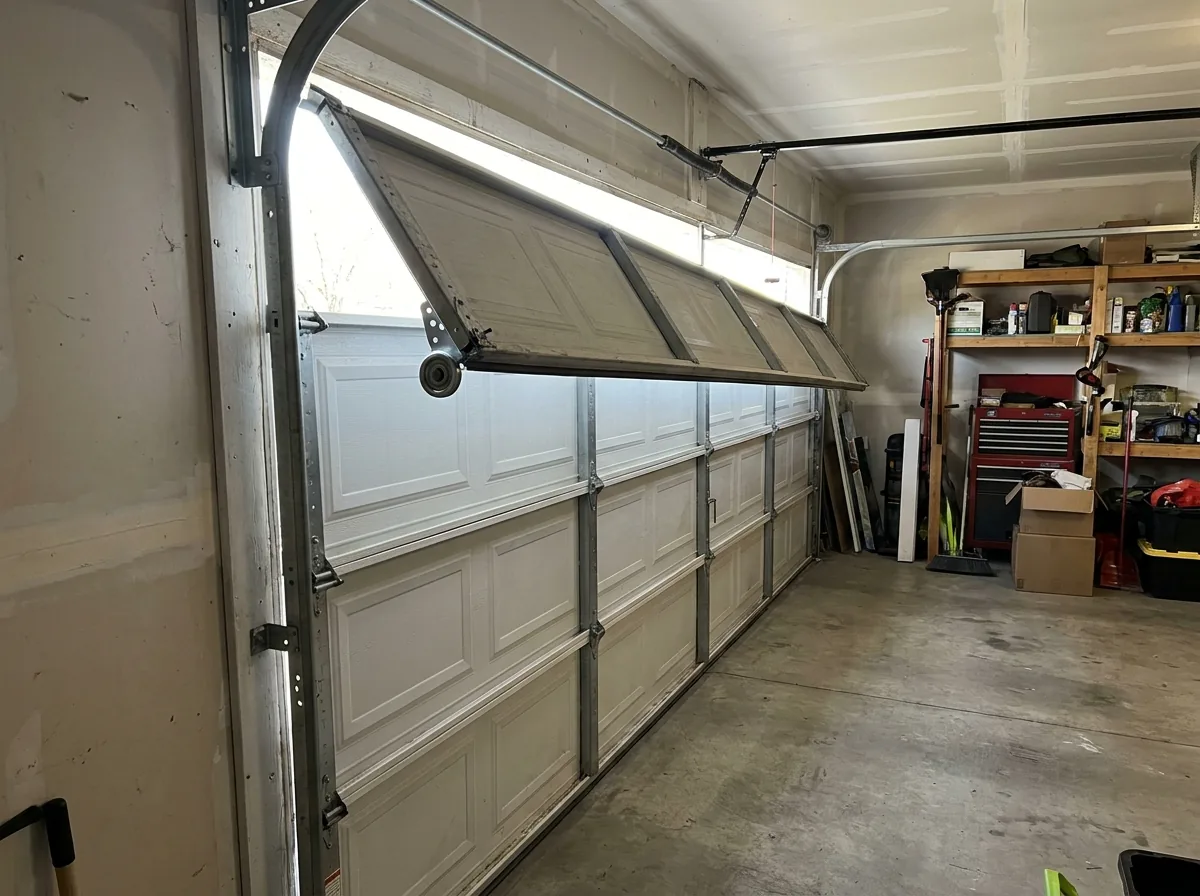
Garage Door Stuck Halfway: Causes and What to Do
A garage door stuck halfway is usually a seized roller, a bent or rusted section of track, a frayed cable, or an opener travel limit that has drifted. If it stops at the same point every time, the cause is mechanical and sits at that height on one of the tracks. If it stops at different points, it is more often the spring balance or the opener force setting. Track repair starts at $140, cable repair at $95, and a tune-up that resets limits and lubricates the hardware is $85 to $160.
Same place every time, or different places
This one distinction narrows it down faster than anything else.
Same point, every time. Something physical is in the way at that height. Look at both tracks at that exact position for a dent, a bulge, a rust patch, a loose bracket, or a roller that is not sitting fully in the track. Then look at the hinges on the section joint that is level with the stop point.
Different points, or gradually worse. More likely the spring balance, a stretching cable, or an opener that is losing force in the heat. A door that used to run cleanly and now stops a little higher each month is telling you the springs are tired, and our article on a door that opens slowly covers that path.
The manual test
Pull the manual release with the door closed if you can get it there. Then lift the door by hand, slowly, through its whole travel.
You are feeling for two things: a point where it becomes hard to move, and whether it holds position when you let go.
A rough spot at one height confirms the mechanical cause. A door that will not hold halfway confirms the spring balance is off, and that needs to be fixed before anything else is worth doing.
If the door will not move by hand at all, stop. Something is jammed hard enough that pulling on it will make the damage worse.
The usual causes, in order
Seized roller. A roller with a dead bearing does not turn, it slides. It drags, it wears a groove in the track, and eventually it jams at the tightest point in the run. Florida humidity kills roller bearings early, and steel rollers within a few miles of the coast rust solid. Replacing the full set is usually done on a tune-up visit, with the rollers quoted as parts on top of the $85 to $160.
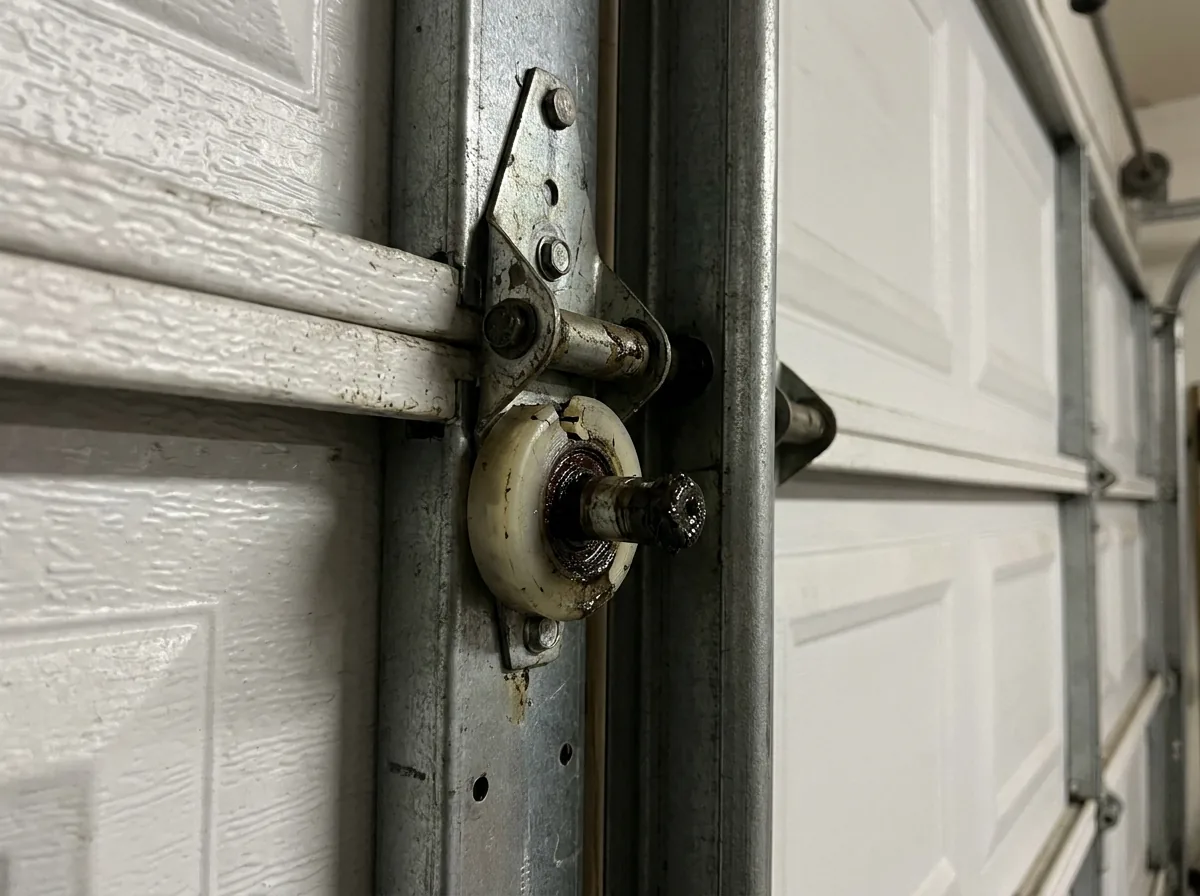
Rusted or bent track. A bump from a car bumper, a ladder leaned against it, or years of a dragging roller. In Florida the more common version is rust at the bottom two feet of the vertical track, where water from the daily afternoon storm runs under the bottom seal and sits against the slab. The flaking metal catches the rollers. Track can sometimes be cleaned and straightened; badly rusted or bent sections get replaced. This is an off-track or track repair from $140, running to $600 for a new section.
Loose track bracket. The track spreads under load and the roller comes half out. Common on doors that have never been serviced, and on older CBS houses where the lag bolts into the jamb have worked loose over decades of cycling.
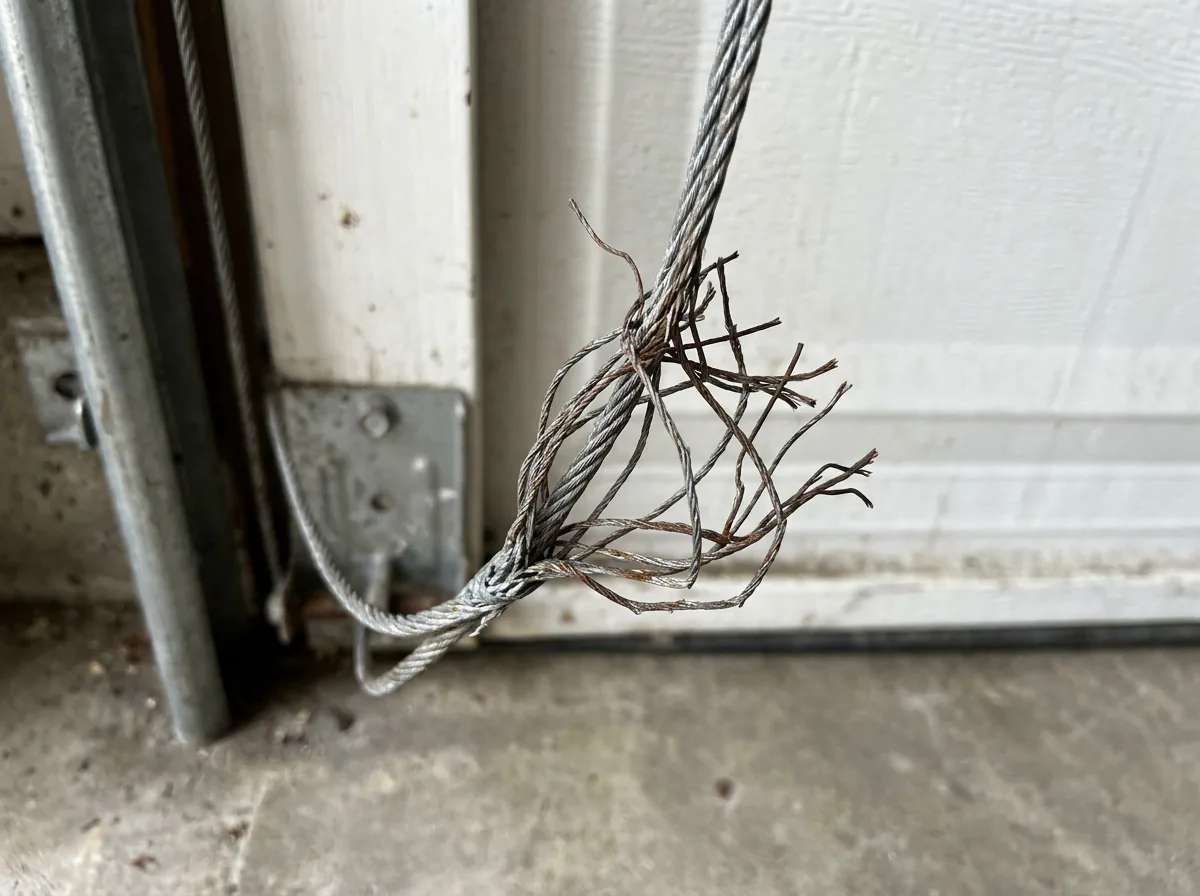
Frayed or stretched cable. One side loses support, the door goes crooked, and it binds in the tracks. Rust on a cable is the most common visible warning we see in Florida, and a rusted cable frays strand by strand until it lets go. This one is urgent because the next step is the door coming off the track entirely. Cable repair is $95 to $300, or $225 to $400 with the drum. If the door is already visibly crooked, read our guide to a crooked or uneven door.
Cracked hinge. End hinges carry the roller. A cracked one lets the roller shift out of line, and the door binds at that section every time. Hinges are quoted as parts on a service visit with labor at $45 to $120 per hour.
Travel limits. If the opener stops the door at the same point and the door moves freely by hand through that spot, the limit setting is the answer. Limits drift on older units, and on some models they reset after repeated power cuts. Resetting limits is part of a tune-up or an opener repair at $95 to $300.
Opener force in the heat. An opener whose force setting is marginal will move the door fine at 7 in the morning and stop halfway at 4 in the afternoon when the garage is 105°F and the motor has lost torque. If the problem is worse on hot afternoons and the door moves freely by hand, look at the opener before the hardware.
Getting the car out
If the door is stuck high enough to drive under, do not. A door held by a jam is not a door you want a car or a person under.
The safe order is: pull the manual release, get the door either fully up and securely propped with locking clamps on both tracks, or fully down, and only then move the vehicle.
If you cannot move the door at all by hand, stop and call. Forcing a jammed door is how a $140 repair becomes a panel replacement at $250 to $800 per section. Our article on a car trapped in the garage covers the options when you need the car now.
What it usually costs
| Cause | What to check | What it costs |
|---|---|---|
| Seized or rusted roller | Roller slides instead of turning, groove worn in track | $85 to $160 tune-up plus rollers |
| Rusted or bent track section | Flaking or dented track at the stop height | $140 to $600 off-track or track repair |
| Loose track bracket | Track spread, roller half out | $140 to $600 off-track repair |
| Frayed or stretched cable | Rust on the cable, door crooked | $95 to $300 cable repair; $225 to $400 with drum |
| Cracked hinge | Roller out of line at one section joint | Parts plus labor at $45 to $120 per hour |
| Travel limit drifted | Door moves freely by hand through the stop point | Part of a tune-up or $95 to $300 opener repair |
| Springs out of balance | Door will not hold halfway by hand | $150 to $350 per spring |
These are the starting prices from our prices page for a standard single door in normal condition. A double door with more than one of these problems is quoted in writing before we start.
Why we see so much of this in Florida
A door in Cape Coral or Clearwater lives in salt air, gets wet at the bottom seal almost every afternoon from June to October, cycles more than a northern door because the garage is the front door, and sits in a room that stays above 100°F all summer. Each of those shortens the life of the rollers, the track and the cables. Our article on salt air and garage door corrosion explains what to look for on a coastal door, and a tune-up every spring, before hurricane season, catches most of it before the door stops halfway with the car inside.
We do this work the same day across Southwest Florida, Tampa Bay, Broward County, Miami-Dade County, Palm Beach and the Treasure Coast, Central Florida and North Florida. Call (561) 897-9930 and tell us the height where the door stops.
Related questions
Is it safe to leave a garage door stuck halfway?
No. A door stopped partway is being held by whatever jammed it rather than by the spring system, and that is not something to rely on. Get it fully down or fully up and secured until it is repaired, and keep people and cars out from under it in the meantime.
Why does my garage door stop in the same place every time?
Something physical is there. A dented track section, a loose bracket, a roller with a seized bearing reaching a tight spot, or a cracked hinge letting the roller shift out of line. Look at that exact height on both tracks and at the hinges on the section joint that is level with it.
The door stops and then reverses. Is that different?
Yes. That is the opener detecting resistance and backing off, which is the safety system working as designed. It still means something is binding, but the opener is telling you instead of forcing through it. The cause list is the same.
Can rust make a garage door stick halfway?
Yes, and in Florida it is one of the most common causes. Water from afternoon storms sits in the bottom of the vertical tracks half the year, the track rusts and flakes, and roller bearings seize from the humidity. The door runs fine for the first two feet and then drags where the rollers hit the rough section.
Should I try to force the door the rest of the way?
No. Forcing a jammed door with the opener is how a roller repair becomes an off-track repair and a bent panel. Pull the manual release, move it by hand if it moves freely, and stop if it does not.